
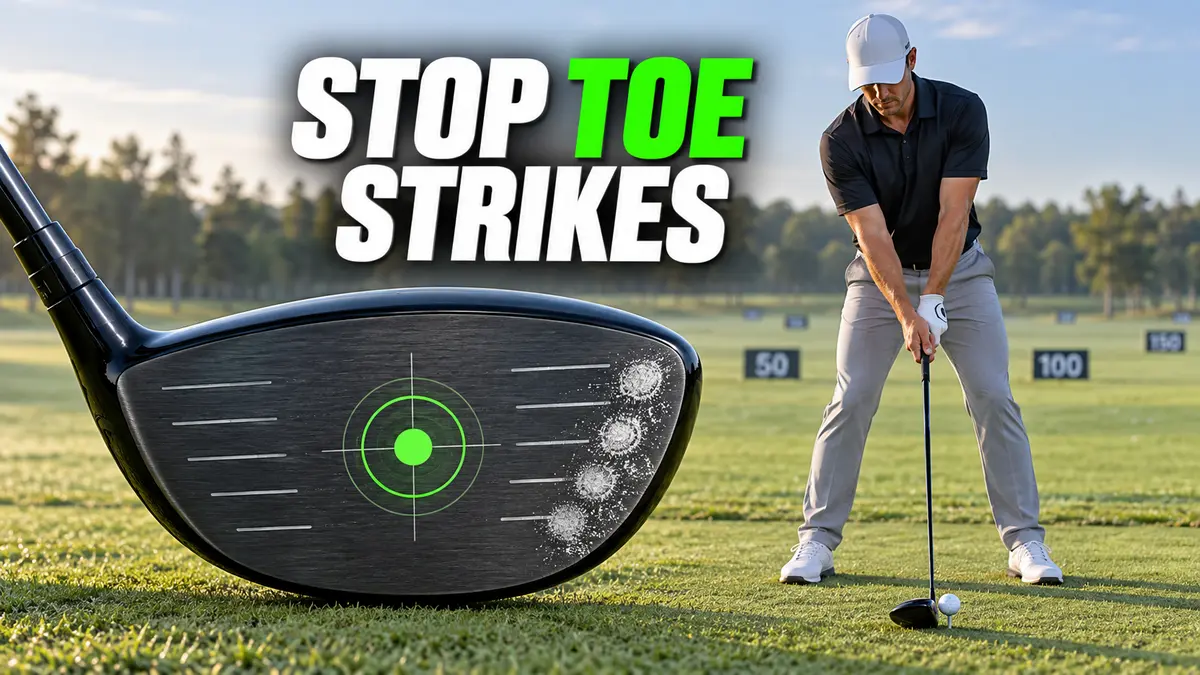
Why You Hit Driver Off the Toe: Causes, Fixes and a 15-Ball Test
Hitting driver off the toe is frustrating because the shot does not always look terrible. One may turn over and find the fairway; the next may start right, curve too much or lose speed.
Do not diagnose a toe strike from ball flight alone. Confirm where the ball contacts the face, then test the simplest setup adjustment before rebuilding your downswing.
My coaching approach is to make this measurable. You will use 15 drives to identify the pattern, compare one setup change and see whether the strike moves. After that, the goal is not one perfect drive. It is hitting the center area on four of five swings.
If inconsistent driving is one of the leaks keeping you in the 90s, use the free Break 90 Toolkit to connect the miss to a practical on-course and practice priority.
What You’ll Learn
- Why toe contact changes driver speed and curvature
- How to confirm your actual strike pattern
- The setup problems that can move contact toward the toe
- Which adjustment to test first
- How to complete the 15-ball toe-strike test
- A four-out-of-five drill for building center-face consistency
- What to do when setup changes do not solve the problem
Why Am I Hitting Driver Off the Toe?
Repeated toe strikes usually mean the distance between you and the ball—or the space available to the club through impact—is changing. You may be reaching at address, moving toward your heels, pulling the handle inward or changing posture.
Those are possibilities, not automatic diagnoses. The same toe mark can be produced by different movements. That is why the best starting point is a face map and a controlled setup test.
What a Toe Strike Does to Driver Ball Flight
The center of the driver face is generally the best place to transfer speed efficiently. TrackMan’s guide to launch-monitor data notes that toe and heel impacts reduce potential ball speed.
Toe contact can also change curvature because a driver face is curved and the clubhead can rotate during an off-center collision. This is commonly called gear effect. TrackMan’s club-data definitions explain that impact location on woods influences the face angle at the contact point and the resulting ball flight.
For a right-handed golfer, a toe strike often adds draw or hook influence. For a left-handed golfer, the direction is reversed. But the final flight still depends on the clubface, swing path, strike height and severity of the miss.
This matters because a ball that hooks is not proof of a toe strike. You can also hook a centered strike with the face closed relative to the path. Spray the face before changing your swing.
How to Check Driver Strike Location
Use athlete’s foot powder spray, impact spray or face stickers. Apply a light coating to a clean driver face.
Hit normal drives from your usual tee height. After each shot, record two things:
- Strike location: heel, center or toe
- Ball flight: start direction and curve
Also record high or low contact. Photograph the face after each five-ball group or draw the strikes on a simple face map.

Five Common Causes of Driver Toe Strikes
1. Standing Too Far From the Ball
This is the first setup issue I would check. When the ball is too far away, the arms and shoulders reach forward. Hinge from the hips and let the arms hang naturally beneath the upper chest. They should feel extended but not rigid.
Use the full six-step driver setup guide if ball position, tee height or posture also changes from swing to swing.
2. Pulling the Handle Inward Through Impact
Pulling the grip closer to the thighs can shorten the effective distance from the body to the clubhead. Do not shove the hands outward at full speed; first see whether a balanced setup and an 80% swing improve the pattern.
3. Losing Balance Toward the Heels
If your pressure rocks toward the heels, your body moves away from the ball. At address, feel pressure through the middle of both feet. The goal is athletic balance, not a frozen position.
4. Changing Posture Through Impact
Standing taller, moving the pelvis toward the ball or raising the handle can alter how the club returns. Film from down the target line at hand height and compare your space at address and impact. Check the video before choosing a posture drill.
5. A Driver That Is Difficult to Center
A longer driver may be harder to center. Grip down one-half inch for five swings. If the pattern tightens, club length may be worth discussing with a qualified fitter. Do not alter the club after one session.
The Setup Change to Test First
If you look stretched at address, move approximately one-half inch closer to the ball. That is a small change—about the width of a fingernail—not a complete rebuild.
Then reconstruct your setup:
- Aim the driver face at a precise target.
- Position the ball near the inside of your lead heel.
- Set your feet slightly wider than shoulder width.
- Hinge from the hips.
- Let your arms hang naturally before gripping the club.
- Check that your pressure feels centered through the feet.
- Make one balanced practice swing before hitting.
The purpose is to remove an obvious reach and see whether contact responds. Body proportions differ, so judge the distance by balance and strike—not someone else’s hand spacing.
The 15-Ball Driver Toe-Strike Test
This test gives you data before and after one setup change.
What You Need
- Driver and 15 golf balls
- Face spray or impact stickers
- Five tees set to the same height
- One fairway-width target
- Notes app or paper face map
Warm up first and use a flat hitting area when possible.
Set 1: Five Baseline Drives
Use your normal setup and normal playing swing. Do not try to find the center by steering the club.
Record heel, center or toe; high, middle or low; and the starting direction and curve. This confirms whether the toe pattern repeats.
Set 2: Five Setup-Change Drives
Make one change only. If you were reaching, stand approximately one-half inch closer while allowing the arms to hang naturally. Keep the same tee height, target and swing intention.
Record all five. If four marks remain on the toe, the change probably missed the cause. If the cluster shifts toward center, keep it for the final set.
Set 3: Five Confirmation Drives
Use the setup that produced the best contact. Complete your normal pre-shot routine before every ball and swing at roughly 80% effort.
Score the set:
- 2 points: Strike finishes in the center section of the face
- 1 point: Strike is slightly heel- or toe-side but remains playable
- 0 points: Clear toe, heel, crown or low-face miss
Ten points are available. Seven or better with a tighter cluster is a useful first pass. Compare all three face maps rather than judging the best drive.
The Four-Out-of-Five Center-Face Drill
Once the setup test identifies a better address position, turn the correction into a consistency challenge.
Spray the face and hit five drives. Use a full pre-shot routine, the same tee height and one fairway target. Swing at 75–80% effort until the strike becomes predictable.
Your goal is simple: put at least four of five marks in the center section of the face.
If you score three or fewer, repeat at the same speed. Do not add another technical thought; check only the setup adjustment that improved the 15-ball test.
Pass the challenge twice before adding speed. Then progress through three levels:
- Four of five center strikes at 75–80% effort
- Four of five center strikes at normal playing speed
- Four of five center strikes while changing targets and completing your full routine
If you want this drill placed inside complete range, short-game and putting sessions, choose a structured Foy Golf Academy practice plan for your current level.
When the Problem Is More Than Setup
If four or five toe strikes remain after two setup tests, record the swing. Check whether:
- Your hips move substantially closer to the ball
- Your chest rises early
- Your balance moves toward the heels
- The grip moves sharply inward through impact
- The handle is much higher at impact than at address
Work on the clearest pattern with a coach. The problem is easier to solve when you connect the face map to one visible movement. If your adjustment creates the opposite miss, compare it with this guide to heel contact.
Common Mistakes When Fixing Toe Contact
- Changing three things at once: Change one variable and give it five balls.
- Swinging harder: Begin at 75–80% effort and earn more speed by passing the drill.
- Diagnosing from curvature: A hook can come from toe gear effect, face-to-path or both. Check the face.
- Reacting to one shot: Look for a tighter five-shot cluster, then confirm it.
Frequently Asked Questions
Does standing closer to the ball fix toe strikes?
It can help when reaching is the cause. Move only about one-half inch closer and test five shots. If the strike does not move, investigate balance, posture and handle movement.
Why does a toe strike with driver often hook?
An off-center collision can rotate the clubhead and tilt the ball’s spin axis through gear effect. For a right-handed golfer, toe contact commonly adds draw or hook influence. Clubface and path still affect the final flight.
Can a toe strike still go far?
Yes. A slightly high-toe strike can produce a playable flight. However, repeated off-center contact generally reduces potential ball speed and makes curvature less predictable.
Can gripping down help driver toe strikes?
Gripping down one-half inch is a useful test if the club feels difficult to center. It shortens the effective playing length and may tighten the strike pattern. Test five balls before considering an equipment change.
Final Thoughts
If you keep hitting driver off the toe, stop guessing from the ball flight. Spray the face, collect five baseline strikes and test one setup change at a time.
Begin by checking whether you are reaching for the ball. Move slightly closer only when the setup looks stretched, let the arms hang naturally and keep your pressure centered. Use the 15-ball test to find the better position, then train it until you can strike the center area on four of five drives.
The goal is not to manufacture one perfect swing. It is to build a repeatable setup that produces a tighter impact pattern.
For complete sessions that organize driver contact work with the rest of your game, explore the Foy Golf Academy practice plans.