
How Much Distance Do Golf Balls Lose in Cold Weather?
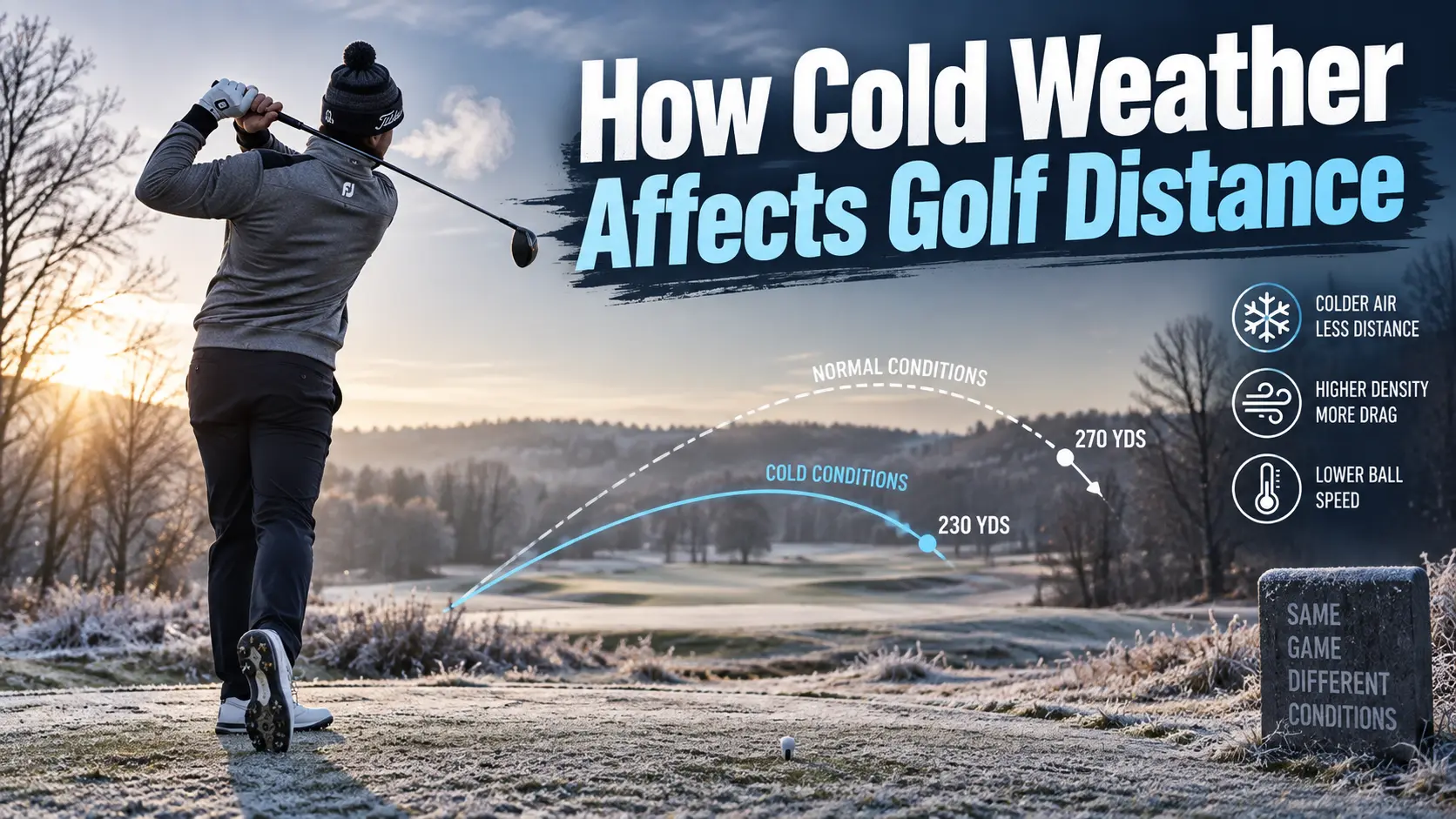
One of the first things I notice when playing golf in cold weather is that the ball does not seem to travel as far.
The strike can feel solid. The shot can start on the correct line. Then the ball lands short of the distance I expected.
I have seen the same thing with my students. In some cold-weather rounds and practice sessions, we have experienced shots finishing roughly 10 to 15 yards shorter than expected. That does not mean every golfer automatically loses a full club whenever the temperature drops. It means your normal summer yardages may no longer be reliable.
Cold air affects the golf ball, but the weather also affects your body and the course. Your hands can hurt. Your muscles may feel tighter. Extra clothing can restrict your turn. Your swing speed may feel slower, and soft turf can remove much of the rollout you normally receive.
When several of those factors appear together, taking more club is often smarter than trying to force your normal club to reach the number.
Why Golf Balls Travel Shorter in Cold Weather
There are two different questions to separate:
- How much distance does the golf ball lose because of temperature?
- How much distance does the entire golf shot lose under cold-weather playing conditions?
Those are not always the same number.
Titleist’s explanation of temperature and golf-ball performance says colder air is denser than warmer air. That creates more drag and produces a slightly higher, shorter flight. Titleist offers a general guideline of about a 1.5 percent distance loss for every 20-degree Fahrenheit drop in temperature.
Using that guideline, a 150-yard shot might lose only a few yards from air temperature alone.
But golfers may see a larger real-world difference because the air is only one part of the shot.
Your Body May Produce Less Speed
Cold weather can make your hands hurt and your body feel tighter. I notice this in my own game, and I have seen it with students.
When your body does not move as freely, your swing may feel slower. You might shorten your turn or protect your hands without realizing it. Thick layers can also restrict your rotation.
Even a small reduction in clubhead speed can cost additional carry distance.
A Cold Golf Ball Can Perform Differently
Titleist also explains that a golf ball that becomes too cold can lose some resiliency, reducing its initial velocity after impact. Their recommendation is to store golf balls indoors and begin the round with them near room temperature instead of leaving them in a freezing car or garage.
That does not require changing to a completely different golf ball for winter. Playing a familiar ball and learning its cold-weather distance can be more useful than changing equipment and introducing another variable.
The Course May Provide Less Roll
Fall and winter turf is often wet and soft. A drive that normally lands and releases can stop quickly. An approach shot may plug or finish close to its pitch mark.
That lost rollout does not change your carry distance, but it absolutely changes the total distance of the shot.
If you want a broader plan for clothing, warmups, equipment, and course conditions, read my guide on how to play golf in the winter.
Cold-weather distance mistakes can quickly turn into penalty shots, difficult recovery shots, and big numbers. Use my free Break 90 Toolkit and Shot Leak Audit to find which mistakes are costing you the most shots.

Why I Often Have Students Take More Club
When my students begin losing distance in cold weather, I usually have them club up for a while.
That may mean hitting a 6-iron instead of trying to force a 7-iron to travel its normal summer distance. The goal is to make a controlled swing with enough club, not swing harder with cold hands and a tight body.
Trying to manufacture extra speed can make contact worse. A golfer who is already uncomfortable may rush the transition, lose balance, or miss the center of the face. The harder swing can create a shorter shot if the strike quality drops.
Taking more club gives you room to make your normal motion.
The adjustment should remain temporary and evidence-based. Do not decide before the round that every shot requires exactly one extra club. Test what is happening that day, then adapt.
Use the First Few Shots to Learn the Day’s Distance
Cold-weather yardages can change from one day to the next. Temperature, wind, moisture, clothing, and how your body feels all matter.
That is why I prefer a quick test instead of relying on one universal formula.
You can perform the test on the driving range or during a practice round.
Option 1: Test at the Driving Range
Choose a visible target with a known distance. Use a mid-iron that you know well, such as a 7-iron.
Hit 10 shots while making your normal controlled swing. Ignore the obvious mishits, but do not remove every shot that finishes short. You are trying to identify the day’s pattern, not protect your normal yardage.
Record:
- Target distance
- Club used
- Approximate carry distance
- Quality of contact
- Wind direction
- Approximate temperature
If most solid shots finish 8 to 12 yards short of your usual carry, use that information when choosing clubs on the course.
Repeat the test with a wedge and a longer club if you have enough time. You may discover that the distance change is not identical throughout the bag.
Option 2: Test During a Practice Round
A practice round lets you test distance under actual course conditions.
Use a GPS app such as 18Birdies to estimate the distance to the middle of the green. You can also use numbered sprinkler heads, fairway distance markers, or pace off the distance from a known marker.
Imagine that the app shows 150 yards to the middle of the green. You hit a solid shot that finishes approximately 10 yards short of the middle.
That result does not prove your club always travels exactly 10 yards shorter in cold weather. The strike, wind, elevation, and green firmness still matter. But it gives you useful evidence.
If another solid shot produces a similar result, you have a pattern. Take more club on the next comparable approach and see whether the adjustment improves your distance.
When the round does not count, hit an extra ball when the course is clear and the rules allow it. Compare your normal club with one additional club from the same location. This is one of the fastest ways to learn whether clubbing up solves the problem.
Resource: Grab these 50 practice templates… organized into Driving Range, Chipping, and Putting so you’re not guessing what to work on. Learn more on our home page.
The Cold-Weather Distance Test
Use this simple test to build a temporary yardage adjustment for the day.
Step 1: Establish the Distance
Use your GPS app, a range target, a sprinkler head, or a marked distance post. Choose a level shot when possible so elevation does not distort the result.
Step 2: Hit Your Normal Club
Select the club you would normally use in warmer conditions. Make a balanced swing rather than trying to create extra speed.
Step 3: Judge the Strike
Only use the result if the contact was reasonably solid. A heavy, thin, heel, or toe strike tells you more about contact than temperature.
Step 4: Compare the Finish
Estimate how far the shot finished short or long of the intended landing area. For an approach shot, compare the ball’s landing or finishing position with the front, middle, and back of the green.
Step 5: Test One More Club
During a practice round, hit a second ball with one additional club. Keep the swing effort similar. If the second shot covers the expected distance more easily, use that adjustment for the next few holes.
Step 6: Confirm the Pattern
Do not build your entire cold-weather strategy around one shot. Look for two or three solid strikes that show a similar distance loss.
For a more complete approach to learning your yardages, use my guide to distance control and scoring.
Separate Temperature From Wind
Cold days are often windy, but temperature and wind require different adjustments.
A cold, calm day may simply require more club because the ball and your swing are producing less distance. A cold day with a strong headwind can require a larger adjustment and a different trajectory.
Do not blame every short shot on temperature. Before selecting a club, check:
- Actual yardage
- Wind direction and strength
- Elevation change
- Lie quality
- Front, middle, and back green distances
- Where the safest miss is located
- How your body and swing feel
My guide to how wind affects the golf ball and club selection explains that variable in more detail.
Avoid These Cold-Weather Club-Selection Mistakes
Swinging Harder With the Same Club
If your body already feels tight, an aggressive swing can reduce contact quality. Take enough club to make a controlled swing.
Assuming Every Shot Loses Exactly 10 Yards
My students and I have sometimes seen 10 to 15 yards of total distance loss, but that is a personal observation, not a universal formula. Your results depend on your speed, strike, club, temperature, wind, clothing, and turf.
Test the conditions you are actually playing in.
Ignoring the Difference Between Carry and Total Distance
A shot may lose a few yards in the air and even more after landing because soft turf provides little rollout. Consider both numbers when selecting a club.
Firing at a Front Hole Location
If you are unsure about your cold-weather yardage, aiming at a front pin leaves very little margin for error. Use the middle of the green as your reference and choose enough club to cover the front.
Trusting a Mishit as Your New Yardage
A poor strike does not establish a cold-weather distance. Use solid shots to identify the pattern, then account for the fact that cold hands and extra layers may make solid contact harder to repeat.
Build a Cold-Weather Yardage Note
After the round, add a short note to your phone:
- Date and temperature
- Clubs tested
- Normal carry distance
- Estimated cold-weather carry
- Wind and turf conditions
- Adjustment that worked
You do not need a perfect winter yardage chart after one round. Collect information across several cold days.
For example, you may learn that taking one extra club works well for your mid-irons when the temperature drops, while wedges require a smaller adjustment. You may also find that your driver loses more total distance because the fairways are soft and the ball stops quickly.
That information is more valuable than copying another golfer’s temperature formula.
Want a complete structure for testing contact, distance control, chipping, and putting? My Foy Golf Academy Practice Plans give you 50 organized practice sessions for your skill level.
Let the First Few Shots Set Your Expectations
Cold-weather golf becomes frustrating when you keep expecting summer distances.
I have experienced shots finishing 10 to 15 yards shorter in the cold, and I have seen the same thing with students. Cold hands, a tighter body, a slower-feeling swing, dense air, a colder ball, restrictive layers, and soft turf can all contribute to the result.
Instead of forcing the same club, test the conditions.
Use a range target, GPS app, sprinkler head, or marked distance post. Hit your normal club, evaluate the strike, compare the result with the expected yardage, and test one more club when possible.
If the pattern says you are coming up short, take more club for a while and make a controlled swing.
Ready to practice with clearer goals instead of guessing? Choose the Foy Golf Academy Practice Plan that fits your game and give every session a purpose.