
How to Break 90 in Golf: Stop Turning One Bad Shot Into Three
If you’re trying to break 90 in golf, here’s something I want you to understand before you make another swing:
You don’t need to eliminate every bad golf shot to shoot in the 80s.
You’re still going to chunk an iron. You’re going to hit a drive into the rough. You’re going to misjudge a chip. You might even three-putt.
I’ve coached enough golfers to know that telling an average golfer to simply “hit better shots” isn’t much of a strategy.
The bigger problem I see is what happens after the first bad shot.
A golfer hits a poor drive, tries an aggressive recovery shot, gets into more trouble, chunks the next one and suddenly a hole that could have been a bogey turns into a triple.
That’s the cycle we need to break.
If your goal is to break 90, we’re going to accept that bad shots will happen. Then we’re going to build a strategy that keeps those mistakes from destroying your scorecard.
The Math Behind Breaking 90
There’s a simple way I like to explain the goal:
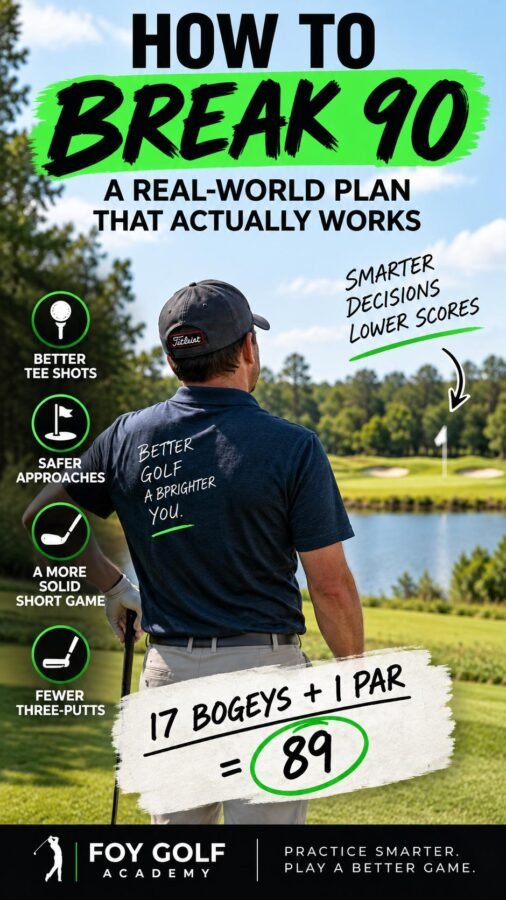
17 bogeys + 1 par = 89.
Obviously, your actual scorecard probably won’t look exactly like that. You might make a few pars, some bogeys and unfortunately a double or two.
The point is that you don’t need to play spectacular golf.
You don’t need five birdies.
You don’t need to hit every green in regulation.
And you definitely don’t need to attack every flag.
You need to keep the ball in play, give yourself opportunities to hit greens, manage your misses and prevent the really big numbers.
That’s a very different way of playing golf.
Want my complete Break 90 game plan?
I put together a free Break 90 Blueprint that walks you through the course strategy, setup, contact, short game and putting skills I want golfers working on to start shooting in the 80s. Get the Free Break 90 Blueprint → Click Here
The Two Biggest Problems I See: Bad Contact and Poor Decisions
When I work with golfers who struggle to break 90, two problems show up repeatedly:
Bad contact and poor decision-making.
We can improve the contact through practice, but you’re probably not going to completely fix your golf swing before your next round.
That’s where better decisions can immediately save strokes.
One of the biggest mistakes I see is golfers choosing a shot based on the best possible outcome rather than considering what happens if they don’t execute it perfectly.
They hit driver on a narrow hole because they want a wedge into the green.
They attack a tucked flag instead of aiming away from trouble.
They hit a low-lofted club out of thick rough because they’re still trying to reach the green after a poor drive.
All of those decisions can work.
But what happens when they don’t?
That’s what a golfer trying to break 90 needs to start thinking about.
You Don’t Have to Hit Driver on Every Par 4
Imagine we’re standing on a tight par 4 with trees running down both sides of the fairway.
You could hit driver and, if you hit it perfectly, leave yourself a 100-yard wedge.
That sounds great.
But what happens when the driver isn’t perfect?
Now you’re punching sideways through trees, hitting out of thick rough or potentially taking a penalty.
Instead, I might tell a golfer I’m coaching:
Let’s take a club that leaves us about 155–165 yards from the green.
Now we’ve made the fairway much easier to hit.
We don’t need driver followed by a 100-yard wedge.
I’d rather have you hitting a longer second shot from the fairway than trying to manufacture a recovery shot from behind a tree.
One of the things I say frequently is:
Golf is a lot easier from the fairway.
Maximum tee-shot distance isn’t always the best strategy.
Distance only helps when you still have a usable second shot.
After a Bad Drive, Take Your Medicine
Here’s another situation I see all the time.
You’ve hit your drive into the rough.
There are trees between you and the green, and there’s a large pond you need to carry to reach the putting surface.
Technically, you might have a shot.
But should you hit it?
For a golfer trying to break 90, I’m probably telling you to take your medicine.
Hit back into the fairway and stay short of the water.
Now you’re hitting your third shot onto the green.
Could you still make par? Absolutely.
But more importantly, we’ve made bogey a very realistic outcome while dramatically reducing the chances of making double or triple.
Compare that with trying to thread a low shot through the trees, carry the pond and somehow reach the green.
If that shot fails, you’ve potentially compounded one mistake with another.
That’s exactly what we’re trying to eliminate.
One bad shot doesn’t have to become a bad hole.
Stop Aiming at Every Flag
Another mistake I see from golfers trying to lower their scores is automatically aiming at the flag.
The flag isn’t always your target.
If there’s trouble around one side of the green, I’m perfectly happy having a golfer aim toward the safer portion of the green.
In some situations, I’m not even worried about getting the ball all the way to the hole.
I want you choosing a club you can hit consistently and trying to reach the front of the green.
Even finishing slightly short can be perfectly fine.
If a golfer struggles with a high approach that can miss dramatically left or right, we may even choose a lower-flighted punch shot that lands short and rolls toward the green.
It isn’t as pretty.
But the lower shot can stay straighter and keep us in play.
We’re trying to shoot a score—not win an award for the best-looking approach shot.
Your Short Game Needs a Strategy Too
Around the green, two contact problems I commonly see are chunked chips and thin chips.
But there’s another problem that doesn’t get talked about enough:
Golfers aim every chip directly at the flag.
A chip isn’t a straight-line shot from your ball to the hole.
The green has slopes and break.
You need to choose a landing spot and understand what the ball is going to do after it lands.
That’s why I like golfers to practice landing spots instead of mindlessly hitting chips toward a flag.
Pick a spot on the green.
Try to land the ball there.
Then watch how far it rolls.
Once you understand the relationship between landing spot and rollout, you can start predicting how the ball will react on the course.
And if bunkers are a major weakness for you, course management becomes even more important.
Until your bunker play improves, there’s nothing wrong with deliberately playing away from them.
Know your weaknesses and manage the course accordingly.
Your Putting Goal Isn’t to Make Everything
If you’re trying to break 90, I don’t need you making 25-foot putts all day.
I want to eliminate unnecessary three-putts.
From 30 feet and closer, let’s make two-putting our expectation.
When we’re outside 30 feet, the first goal is distance control.
Let’s lag the ball within about five feet of the hole and give ourselves a chance to make the next one.
Then we need to become more confident from three and four feet.
One mistake I see on shorter putts is golfers under-reading the break.
Give the putt a chance.
A golfer trying to break 90 doesn’t need an incredible putting performance.
We need predictable speed, better reads and fewer three-putts.
I Once Had a Beginner Play With Almost Nothing but a 9-Iron
One golfer I coached was completely new to the game and couldn’t hit their driver.
In fact, several clubs were causing problems.
Instead of insisting that they use every club because that’s how golf is “supposed” to be played, we simplified things.
We started hitting 9-irons off the tee.
Why?
Because they could hit the 9-iron more than 100 yards consistently.
With some of the other clubs, a bad swing might send the ball only 20 yards.
The 9-iron wasn’t going to produce impressive tee-shot distance, but the ball kept moving toward the hole.
Eventually, this golfer grooved their swing motion and started hitting drivers and other irons much better.
But for a while, we were able to lower their scores simply by relying on the few clubs they could hit and temporarily taking the problem clubs out of the equation.
That’s an important lesson for golfers trying to break 90.
Play the game you have today—not the game you wish you had.
If your hybrid is reliable and your driver isn’t, there’s nothing wrong with hitting hybrid.
If your 7-iron is predictable but your 5-iron is a disaster, don’t force the 5-iron just because the yardage says you’re supposed to hit it.
Your scorecard doesn’t care which club you used.
The Part About Breaking 90 That Gets Oversimplified
There’s a lot of advice online that makes breaking 90 sound incredibly simple.
“Just stop hitting driver.”
“Hit this club instead.”
“Never go for the green from this distance.”
Course management absolutely matters, but I think that advice sometimes ignores the reality of playing golf at this level.
You’re still going to make bad swings.
You can choose the perfect club and chunk it.
You can aim toward the safe side of the fairway and still hit it into the rough.
You can choose the middle of the green and miss.
That’s okay.
The real skill is preventing that mistake from spiraling.
Don’t follow a chunked iron with an unnecessarily aggressive shot because you’re angry.
Don’t try to “get the stroke back” immediately.
Don’t turn one double bogey into three more because you’re frustrated.
Accept the bad shot, reassess the situation and make the smartest decision available with the shot you have now.
Learning to recover mentally can save as many strokes as learning another swing technique.
How I’d Warm Up Before Trying to Break 90
If I had only 30–60 minutes with a golfer before sending them onto the course to try to break 90, I wouldn’t spend the entire session rebuilding their golf swing.
I’d prepare the shots they’re actually going to need.
1. Start With Irons Off a Tee
Make some smooth swings and focus on contact.
Don’t chase speed.
We’re trying to find a comfortable tempo that we can take onto the course.
2. Hit Irons Off the Ground
Take the same smooth tempo and start hitting normal iron shots.
Again, we’re not trying to find another 10 yards.
We’re looking for predictable contact.
3. Practice Chip Landing Spots
Move to the short-game area and hit chips while focusing on where the ball lands.
Once you’re controlling the landing spot, start hitting toward a hole and pay attention to how the ball rolls across the green.
We’re learning the speed of the greens before the round starts.
4. Hit Lag Putts
Roll some longer putts and focus almost entirely on distance control.
Can you consistently finish near the hole?
That’s more important right now than trying to hole 30-footers.
5. Finish With 3–4 Foot Putts
Before leaving the practice green, make some short putts.
See a few balls go into the cup and build confidence before walking to the first tee.
Then go play.
This is also why I’m big on structured practice instead of just hitting balls. If you know three-putts, poor contact or inconsistent chipping are costing you strokes, your practice sessions should be built around improving those weaknesses. That’s exactly why I created my Golf Practice Plans—to give golfers a structured session to follow instead of showing up at the range and randomly hitting balls.
A Better Break 90 Checklist
When you’re on the course, keep coming back to these questions:
- Can I choose a tee club that keeps the ball in play?
- Where is the biggest trouble on this hole?
- Can I aim away from it?
- What club am I hitting consistently today?
- After a bad shot, what’s the safest way back into position?
- Can I get my approach near the front of the green?
- Where should my chip land before it rolls toward the hole?
- Can I avoid three-putting?
- Am I making this shot because it’s smart—or because I’m trying to make up for the previous one?
Most importantly:
Let’s hit fairways and greens instead of trying so hard to make birdies.
There will be opportunities to make pars along the way.
Take them when they come.
Breaking 90 Starts With Managing Your Mistakes
The golfer who shoots 89 isn’t necessarily the golfer who hits the most impressive shots.
Sometimes it’s simply the golfer who makes fewer disastrous decisions.
You’re going to hit bad shots.
Expect them.
Then learn how to respond to them.
Hit the ball back into play.
Aim away from trouble.
Use the clubs you trust.
Accept bogey when bogey is the smart outcome.
Improve your contact through deliberate practice between rounds.
And remember:
You don’t have to recover from a bad shot with a great shot. Sometimes you just need to recover with a smart one.
Want a Plan for Breaking 90?
If you’re not sure which parts of your game are costing you the most strokes, start with my free Break 90 Blueprint.
It will help you look at your course strategy, setup, contact, short game and putting so you can identify what needs the most work.
And once you know your weaknesses, don’t just hit random balls at the range.
My Foy Golf Academy Practice Plans give you structured practice sessions so you know what to work on when you get to the range, short-game area or putting green.
The goal isn’t just to practice more.
It’s to practice the skills that are actually keeping you from breaking 90.