
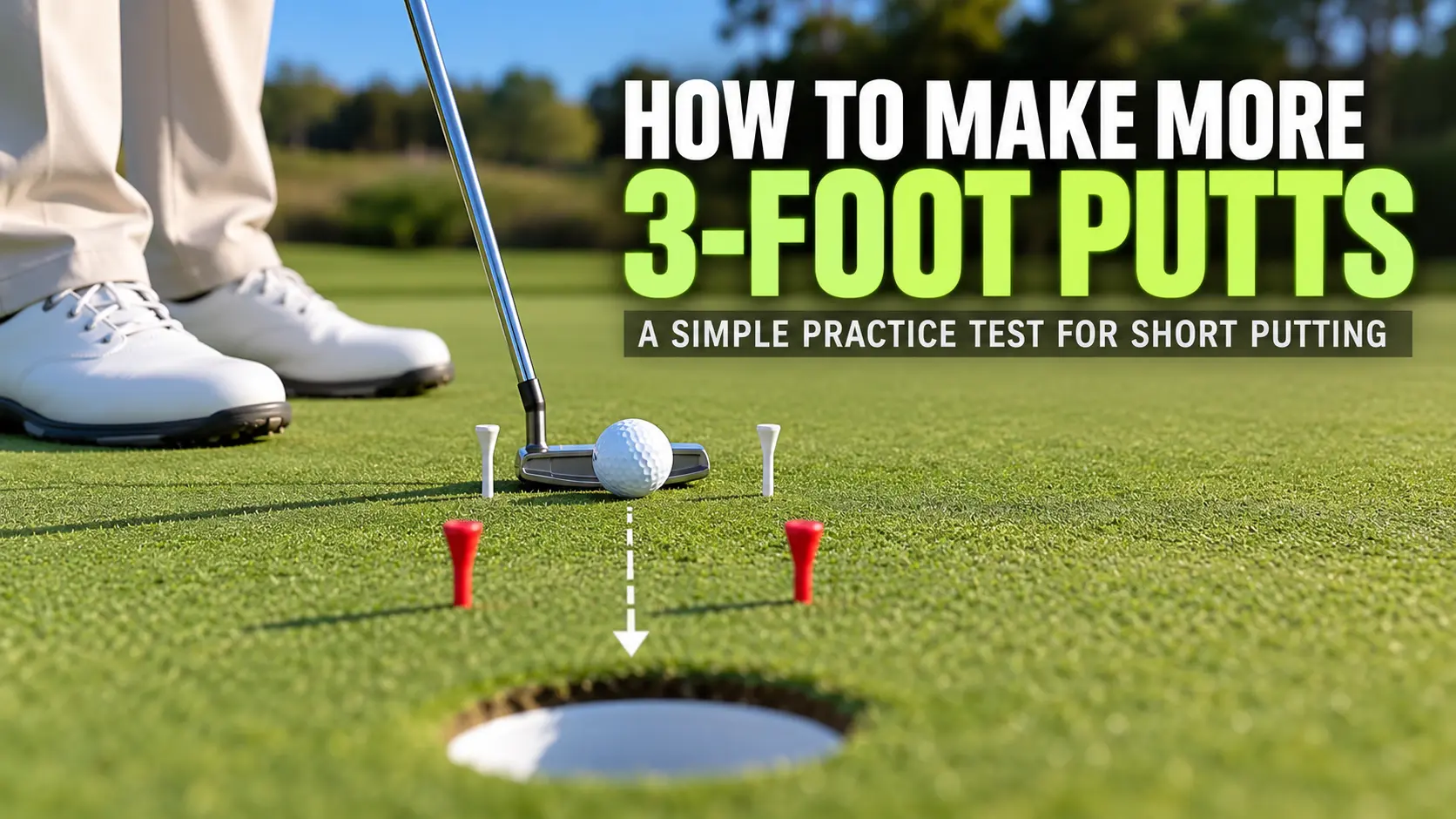
How to Make More 3-Foot Putts: Short Putting Practice Test
You will miss a three-foot putt again. Every golfer does.
The goal is not to become perfect from three feet. The goal is to make more of them, understand why you miss, and build a short-putting routine you can trust when the score matters.
When I work with golfers who struggle from three feet, I do not begin by completely rebuilding their putting stroke. I first look at four things:
- Aim
- Start line
- Face contact
- Routine
A short putt can miss with only a small putter-face error, which is why golfers need specific feedback instead of simply hitting ball after ball toward the hole.
Why Three-Foot Putts Miss
Most short-putt misses fall into one of five patterns:
- The putter face was aimed incorrectly.
- The face opened or closed during the stroke.
- Contact came from the heel or toe.
- The golfer misread a breaking putt.
- Pressure changed the golfer’s routine or speed.
The problem is that simply watching the ball miss does not always tell you which mistake occurred.
That is why I like using a test first.

The 25-Ball Three-Foot Putting Test
Choose one hole and create five different three-foot putts around it.
Try to include:
- A straight uphill putt
- A straight downhill putt
- A right-to-left breaking putt
- A left-to-right breaking putt
- A mild slope of your choice
Place one marker at each position.
Hit five putts from each location for a total of 25 putts.
Instead of hitting all five balls from one spot before moving on, rotate through the different positions after every putt. This forces you to read, aim, and reset just like you would on the golf course.
Track These Five Things
For every putt, record:
- Made or missed
- Started left, on line, or right
- Missed high or low on breaking putts
- Center, heel, or toe contact
- Whether your routine changed when the score started to matter
Your total score matters, but your miss pattern matters even more.
For example, ten misses that all start to the right require a very different fix than ten putts that start on your intended line but consistently miss on the low side of the hole.
Check Your Aim Before Changing Your Stroke
Before making mechanical changes, make sure you are actually aiming the putter where you think you are.
Set the putter behind the golf ball and place an alignment stick on the ground along your intended starting line.
Step away and check whether the putter face is actually square to that line.
One issue I commonly see is golfers aiming the putter face correctly and then changing the face angle while they move their feet into position.
I prefer this order:
- Aim the putter face.
- Set your feet.
- Take one final look at the target.
- Make the stroke.
For more help with setup and alignment, read my guide on mastering putting alignment.
Use a Start-Line Gate
One of my favorite ways to practice short putting is with two simple gates.
Choose a straight three-foot putt.
Place two tees just wider than the putter head so the putter can swing through them without touching either tee.
Then create a second gate approximately 12 inches in front of the golf ball. Make this gate slightly wider than the ball.
Now hit ten putts.
How to Score the Drill
Give yourself one point when:
- The putter travels through the first gate without touching a tee.
- The ball starts through the second gate.
The hole tells you whether the putt went in.
The gates tell you how the stroke produced the result.
That distinction is important.
If you keep hitting the putter-head gate, widen it slightly and make smaller, controlled strokes.
If the putter travels cleanly through the first gate but the ball misses the front gate, check your putter-face angle and strike location.
You may be delivering the putter reasonably well while hitting the ball toward the heel or toe.
Add Pressure to Your Three-Foot Putting Practice
Once you can start the ball on line, add a little pressure.
Place five golf balls around the hole at three feet.
Your goal is to make all five putts to complete one round.
If you miss, restart the round.
However, I do not recommend standing there endlessly until frustration takes over.
Set a limit of about ten minutes.
Record the longest streak you completed during the session.
The next time you practice, your goal is simply to beat that streak.
That makes the drill competitive without convincing yourself that you must become perfect.
Use the Same Routine on Every Putt
Pressure often exposes changes in routine.
You may stand over the ball longer.
You may take extra practice strokes.
You may stop looking at your intended start line.
You may suddenly try to steer the putter instead of making the stroke you practiced.
Use the same routine every time:
- Read the putt.
- Aim the putter face.
- Set your feet.
- Look once at the target.
- Roll the ball through your chosen start line.
My guide on building confidence over short putts goes deeper into building a repeatable routine.
Retest Your Three-Foot Putting
After completing the start-line gate drill and pressure game, repeat the original 25-ball test.
Use the same five positions.
Rotate between them just like you did during the first test.
Compare:
- Total putts made
- Number of start-line misses
- High-side versus low-side misses
- Heel and toe strikes
- Routine breakdowns
A productive practice session should reduce your dominant error.
For example, if most of your first-test misses started right but your second test shows the ball consistently starting through your intended line, the practice session accomplished something useful even if you still missed a few putts.
If your misses remain completely random, I would check face contact and green reading before making major changes to your putting stroke.
Take Your Short-Putting Routine to the Golf Course
Do not carry three or four putting thoughts onto the golf course.
Practice is where you diagnose problems.
The golf course is where you perform.
When you are standing over a three-footer during a round:
- Choose your line.
- Aim the putter face.
- Trust your routine.
- Roll the ball through your intended starting line.
After your round, write down any short putts you missed and whether the ball started on your intended line.
That small amount of information gives your next practice session a clear purpose.
Instead of saying, “I need to practice putting,” you may discover:
“I missed three short putts today, and every one started right.”
Now you know exactly what to work on.
Practice Short Putts With a Purpose
Making more three-foot putts is not about hitting hundreds of random putts from the same spot.
Test your putting first.
Find the pattern.
Work on the specific weakness.
Then retest it.
That is the same approach I use throughout golf practice: identify the biggest problem, give yourself measurable feedback, and practice something that actually addresses it.
Reduce the big numbers: Get my free Break 90 Blueprint and Shot Leak Audit to identify whether short putts, three-putts, penalty shots, or another scoring leak deserves more of your practice time.
Build putting into a complete practice routine: Explore the Foy Golf Academy Practice Plans.