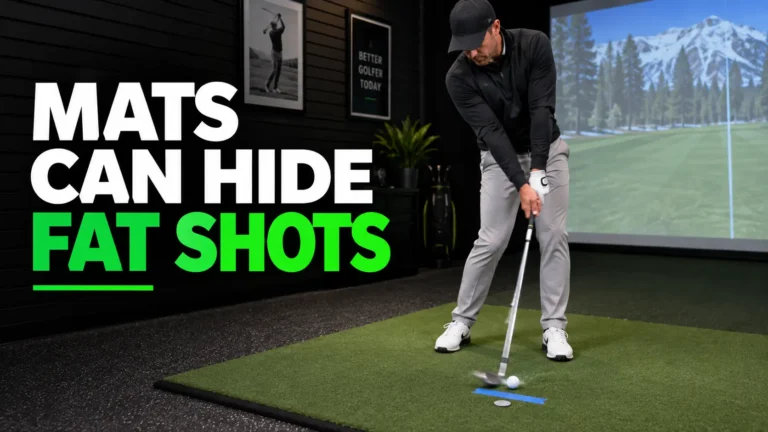
Golf Pre-Shot Routine: 5 Steps for More Consistent Shots
Have you ever stood over a golf ball and suddenly started questioning everything about the shot?
You might be thinking about your grip, your backswing, whether you’re aiming correctly, or what happens if you hit the ball into the water.
Then you make a rushed swing and hit a poor shot.
One of the reasons this happens is that golfers often step up to the ball before they’ve made a clear decision about what they want to do.
They haven’t fully chosen their target, committed to a club, or decided what kind of shot they’re going to hit.
That’s where a golf pre-shot routine can help.
A pre-shot routine is a repeatable process you follow before hitting a golf shot.
It helps you gather information, choose a target, prepare your setup, and commit to the swing.
You don’t need a complicated routine involving five practice swings, multiple deep breaths, or a long list of swing thoughts.
In fact, I prefer keeping the process simple enough that you can use it on every hole without slowing down play.
The goal isn’t to guarantee a perfect shot.
It’s to give yourself a consistent way to prepare so you’re not making a completely different decision every time you approach the ball.
In this guide, I’ll walk you through a five-step golf pre-shot routine you can use with your driver, irons, wedges, and putter.
I’ll also explain how to adjust the routine for pressure situations, what to do after hitting a bad shot, and how to practice the process at the driving range.
For a complete schedule of scored drills and structured sessions, explore the Foy Golf Academy Break 90 Program.
What Is a Pre-Shot Routine in Golf?
A pre-shot routine is a series of actions you repeat before hitting a golf shot.
These actions may include checking the distance, evaluating the lie, choosing a club, picking a target, making a rehearsal swing, aligning your body, and executing the shot.
The purpose is to create a familiar process that helps you prepare physically and mentally.
For example, imagine you have a 150-yard approach shot.
Instead of immediately grabbing your 8-iron and swinging, you take a few moments to evaluate the situation.
You notice that the flag is tucked behind a bunker on the right side of the green.
You decide that aiming toward the middle of the green is a better option.
You choose your club, identify your target, and make a comfortable swing.
That’s a simple example of a pre-shot routine.
The benefit isn’t that the routine magically improves your golf swing.
It’s that you made a deliberate decision and followed a repeatable process.
Pre-Shot Routine vs. Pre-Round Routine
These are two different parts of golf preparation.
Your pre-round routine takes place before you begin playing.
It may include warming up your body, hitting practice shots, putting, and preparing mentally for the round.
Your pre-shot routine happens before individual golf shots throughout the round.
For example, you might spend 30 minutes warming up before your tee time.
But once you’re on the course, you still need a process for choosing and executing each shot.
If you want help with the preparation before your tee time, read my Guide to Building a Pre-Round Golf Routine.
This article focuses on what to do before each actual shot.
Why Every Golfer Should Develop a Pre-Shot Routine
You don’t need to be a professional golfer to benefit from a consistent routine.
I recommend developing one as soon as you begin playing regularly.
Here are some of the reasons.
Better Shot Decisions
A routine encourages you to consider the lie, distance, wind, hazards, and target before selecting a club.
That can help you avoid unnecessary mistakes.
More Consistent Setup
When you approach the ball the same way each time, you have an opportunity to check your alignment, posture, and ball position.
It doesn’t guarantee a technically perfect setup, but it makes your preparation more repeatable.
Less Second-Guessing
Many golfers decide what shot they want to hit, then change their minds while standing over the ball.
A pre-shot routine creates a point where planning ends and execution begins.
Improved Focus
Instead of thinking about the last hole or your final score, you give your attention to the shot in front of you.
Better Practice Habits
Your routine shouldn’t appear for the first time during an important round.
Practicing it on the range helps you become familiar with the process before using it on the course.
The Five-Step Golf Pre-Shot Routine
I recommend organizing your routine into five steps.
- Assess the shot.
- Choose your club and target.
- Visualize and rehearse.
- Align and address the ball.
- Commit and swing.
The first three steps involve planning and preparation.
The last two involve setting up and executing.
You can make minor adjustments based on the type of shot, but I recommend keeping the overall sequence familiar.
Step 1: Assess the Shot Before Choosing a Club
Before grabbing a club, take a moment to understand the shot you’re facing.
I recommend beginning this process while you’re walking or riding toward your ball, provided you can do so safely without distracting other players.
You don’t need to wait until it’s your turn to start thinking.
Check Your Distance
Determine approximately how far you need to hit the ball.
You might use:
- A rangefinder.
- A GPS device or golf watch.
- Course yardage markers.
- A yardage book.
- Your familiarity with the golf course.
You don’t need to use a rangefinder for every single shot.
And there isn’t a rule saying you shouldn’t measure a pitch or chip inside 50 yards.
Use whichever information is appropriate for the situation and permitted under the competition’s rules.
Check the Lie
Next, look at how the golf ball is sitting.
Is it on a clean fairway lie?
Is it sitting down in thick rough?
Is the ball above or below your feet?
Is the ground wet, muddy, or firm?
These conditions may influence how the club contacts the ball.
A 150-yard approach from a clean fairway is different from a 150-yard approach where the ball is buried in rough.
I recommend evaluating the lie before making your final club selection.
Check the Wind and Elevation
Look at the conditions.
A strong headwind might make the shot play longer.
A downhill approach could require less club than the actual measured distance suggests.
You don’t need to calculate every adjustment perfectly.
But you should recognize significant factors before choosing your shot.
Identify the Trouble
Finally, look at the hazards and difficult areas around your intended target.
Where is the water?
Where are the bunkers?
Is the green narrow?
What happens if your shot misses to the left or right?
I recommend considering a safe, acceptable result rather than focusing exclusively on the flag.
Practice tip: Before every full swing during your next round, identify the distance, lie, and primary hazard.
That simple habit can improve the quality of your decisions.
Step 2: Choose Your Club and Target
Once you’ve assessed the situation, make a decision.
This is where I want you to choose the shot you’re actually going to attempt.
Select the Right Club
Use your normal carry distances as a starting point.
Suppose you have 155 yards to the middle of the green.
Your normal 8-iron carries 150 yards, and your 7-iron carries 163 yards.
If the flag is toward the back of the green, your 7-iron might be the better option.
If there’s plenty of safe space short of the hole, the 8-iron could make more sense.
The important part is making the selection based on the shot rather than automatically reaching for the club you normally hit from that yardage.
Choose a Specific Target
Don’t simply decide to hit the ball somewhere toward the green.
Pick a clear target.
That might be:
- The center of the fairway.
- A specific section of the green.
- A tree or landmark in the distance.
- A landing area short of a hazard.
- A particular portion of the putting surface.
Your target doesn’t always need to be the flagstick.
In many situations, aiming away from the flag can be the smarter decision.
Choose an Acceptable Miss
I also like golfers to recognize where they can afford to miss.
For example, imagine a par-three green with water along the left side and a large open area on the right.
Aiming slightly right of the flag might give you a better opportunity to avoid a penalty stroke.
That doesn’t mean you’re intentionally trying to miss the green.
You’re choosing a sensible target based on the risks.
Decide on the Shot Shape
If you regularly play a fade or draw, account for that ball flight.
For example, a golfer who normally hits a fade may choose a starting line slightly left of the intended finishing area.
I don’t recommend trying to manufacture complicated shot shapes just because a hole looks difficult.
Use the shot you can hit most reliably.
Finish the Decision Before Addressing the Ball
This is one of the most important parts of the routine.
Once you’ve chosen the club and target, stop debating the decision.
If you’re still unsure, take another moment behind the ball.
It’s better to make a clear decision before stepping into your stance than to begin changing your mind while you’re ready to swing.

Step 3: Visualize the Shot and Make a Purposeful Rehearsal
Now that you’ve selected your target, prepare for the actual movement.
Many golfers find it helpful to stand behind the ball and picture the shot they intend to hit.
You might imagine the starting direction, trajectory, and landing area.
For example, if you’re hitting a 7-iron toward the middle of the green, imagine the ball starting on your intended line and landing near that target.
What If You Can’t Clearly Visualize a Golf Shot?
That’s fine.
Not everyone experiences mental imagery in the same way.
You don’t have to see a perfect golf shot in your mind.
You can simply identify a target and describe the shot to yourself.
For example:
“Normal 7-iron toward the middle of the green.”
That’s enough to establish a clear intention.
Should You Take a Practice Swing?
You can, but I don’t believe every golfer needs to take multiple practice swings before every shot.
I recommend making one purposeful rehearsal when it helps you feel the movement.
For example:
- Before a driver swing, rehearse a comfortable rhythm.
- Before an iron shot, rehearse a balanced finish.
- Before a wedge shot, rehearse the intended swing length.
- Before a putt, rehearse the pace you want.
If you already feel comfortable and ready, you may not need a rehearsal.
The purpose of a practice swing isn’t to add another task to your routine.
It’s to prepare for the shot.
Avoid Practicing Multiple Swing Fixes
Here’s a mistake I frequently see.
A golfer stands behind the ball and begins rehearsing several different mechanical changes.
First, they work on the takeaway.
Then they rehearse shallowing the shaft.
Next, they try to change the position of their hips.
Finally, they attempt to control the release.
By the time they approach the ball, they’re thinking about four things.
That’s too much to manage during a normal golf shot.
I recommend working on detailed swing changes during dedicated practice.
On the course, use a simple feel or external target that helps you execute the shot.
My Coaching Tip
Try to keep your final rehearsal consistent with the shot you’re about to hit.
If you’re preparing for a controlled wedge shot, don’t make an enormous full-speed practice swing.
Rehearse the movement and tempo you intend to use.
Step 4: Align Yourself and Address the Ball
After you’ve chosen your target and completed any useful rehearsal, step into the shot.
This is the transition from planning to execution.
I recommend approaching the ball in a familiar sequence.
Start Behind the Golf Ball
Stand behind your ball and look down the intended starting line.
This gives you a useful perspective for choosing your alignment.
If it helps, identify a small, visible reference point a short distance ahead of the ball.
It could be a natural mark or an existing blade of grass.
Don’t move or place an object to create an alignment reference during a round when doing so would violate the Rules of Golf.
Aim the Clubface
Step into the shot and position the clubface toward your intended starting direction.
For a normal straight shot, that may be directly toward your target.
For a planned fade or draw, the starting direction may be different from the ball’s intended finishing position.
Your clubface alignment at address is an important reference, but it doesn’t guarantee where the face will point at impact.
Build Your Stance
Once the clubface is positioned, establish your stance.
Check that your feet, hips, and shoulders are reasonably aligned for the intended shot.
Your body alignment doesn’t necessarily need to be perfectly parallel to the target line for every type of shot.
The goal is to establish a setup that supports the ball flight you’re trying to produce.
Check Ball Position and Posture
Before swinging, make sure the ball is positioned appropriately for the club.
Your driver will usually be played farther forward in the stance than a short iron or wedge.
Stand in a comfortable athletic posture.
Let your arms hang naturally.
Avoid reaching excessively toward the ball.
Take Your Final Look
Once you’re comfortable, look at the target one final time.
Return your attention to the ball.
Then make your swing.
I don’t recommend remaining over the ball for a long time while repeatedly checking your stance.
If something feels wrong, step away and restart.
Otherwise, execute the shot you’ve already planned.
Step 5: Commit to the Shot and Swing
This final step is where I want your attention to shift away from planning.
You’ve already checked the distance.
You’ve evaluated the lie.
You’ve selected the club and target.
You’ve rehearsed the movement if necessary.
Now it’s time to swing.
Stop Reconsidering the Decision
If you’ve chosen a 7-iron, don’t suddenly worry that you should have selected an 8-iron while you’re standing over the ball.
That creates uncertainty at the worst possible moment.
You can always make a better decision before stepping into the shot.
But once you’re ready, commit to the one you’ve made.
Focus on a Simple Cue
Some golfers prefer having one simple thought.
Examples include:
- Smooth tempo.
- Balanced finish.
- Swing toward the target.
- Controlled wedge motion.
Others perform better by focusing entirely on the target.
I recommend experimenting to find what helps you swing naturally.
Avoid trying to consciously control several mechanical positions during the downswing.
Make Your Normal Swing
Don’t force extra distance because the hole is difficult.
Don’t slow down abruptly because you’re afraid of missing the target.
Make the swing you’ve chosen.
You may still hit a poor shot.
A good pre-shot routine doesn’t guarantee a good result.
But you can evaluate the decision and execution separately afterward.
That’s an important part of improving your game.
Example Pre-Shot Routine for a Driver
Let’s put the five steps together using a typical tee shot.
Imagine you’re playing a 390-yard par four.
The fairway is relatively wide, but there’s a bunker on the right side.
You normally hit a slight fade with your driver.
Your Routine
Assess: Check the fairway width, wind direction, and location of the bunker.
Choose: Decide to aim toward the left-center of the fairway, allowing room for your normal fade.
Rehearse: Picture the ball starting left-center and moving slightly right. Make one comfortable practice swing if useful.
Align: Step into the shot, position the ball correctly for your driver, and align yourself toward your intended starting line.
Commit: Take one final look and make your normal driver swing.
That’s the complete process.
You don’t need to add a long list of technical adjustments.
The goal is to choose a sensible shot and execute it with confidence.
Example Pre-Shot Routine for an Iron Approach
Now imagine you have 145 yards to the middle of the green.
There’s a bunker guarding the front-right portion.
The flag is positioned behind that bunker.
Your normal 8-iron carries approximately 145 yards.
Your Routine
Assess: Check the distance required to clear the bunker, the wind, and the location of the safest landing area.
Choose: Decide whether the 8-iron gives you enough carry, then select a target toward the middle of the green.
Rehearse: Picture a normal iron shot landing in the intended area.
Align: Aim the clubface, establish your stance, and check your ball position.
Commit: Make a normal swing without trying to steer the ball toward the flag at the last moment.
In this example, choosing the correct target might be more important than trying to hit a technically perfect golf shot.
That’s why I recommend including strategy in your routine.
How to Use a Pre-Shot Routine for Chipping and Pitching
Your short-game routine should follow the same general process, but you need to evaluate different information.
When you’re chipping, the distance to the hole isn’t the only thing that matters.
You also need to think about where the ball should land and how far it’s likely to roll.
Step 1: Read the Lie
Determine whether the ball is sitting on fairway-height grass, thick rough, or another surface.
Your lie can affect the club you choose and the type of shot you attempt.
Step 2: Choose a Landing Spot
Instead of automatically aiming at the flag, select an area where you want the ball to first land.
For a basic chip with plenty of green available, that might be a relatively close landing spot.
For a higher pitch, the landing area may be closer to the hole.
Step 3: Choose the Club and Shot
Consider how much carry and rollout you want.
You might choose a pitching wedge, gap wedge, sand wedge, or another club depending on the situation.
Step 4: Rehearse the Swing Length
Make one or two short rehearsals if they help you establish the intended distance.
Focus on a comfortable, continuous motion.
Step 5: Align and Execute
Aim toward your landing area.
Set up to the ball and make the swing.
Don’t switch your landing target halfway through the motion.
Example: A 25-Yard Chip or Pitch
Suppose your ball is 25 yards from the hole.
There’s 10 yards of fairway before the green, and the flag is positioned another 15 yards onto the putting surface.
Rather than automatically reaching for your highest-lofted wedge, first look at the lie and how much green you have available.
You might decide on a lower chip with a pitching wedge if the path is clear.
Or you might need a higher pitch if there’s an obstacle to carry.
Your pre-shot routine helps you choose that shot before swinging.
For more detailed technique, read my How to Chip a Golf Ball for Beginners guide.
How to Use a Pre-Shot Routine for Putting
Putting requires a slightly different routine because you’re rolling the ball along the green rather than hitting it through the air.
The overall five-step structure still applies.
But the two biggest decisions are usually the starting line and the speed.
Learn how to BREAK 80 in golf with the Break 80 Practice Program.
Read the Green
Before addressing your putt, look at the slope.
Determine whether the ball is likely to break left, break right, or travel relatively straight.
For a longer putt, you may also need to consider uphill or downhill sections along the path.
Choose Your Starting Line
Once you’ve read the green, select the line where you want the ball to begin rolling.
Don’t assume the hole itself is always your starting target.
A breaking putt may require starting the ball outside the cup.
Choose Your Speed
Decide how firmly you want the ball to reach the hole.
For a long putt, your main objective may be leaving a manageable second putt.
For a short putt, you may want a comfortable speed that gives the ball a reasonable opportunity to fall into the hole.
Rehearse the Pace
If a practice stroke helps you feel the distance, make one or two rehearsals while looking at the target or imagining the intended roll.
Then step into your stance.
Aim and Putt
Set the putter face toward your chosen starting line.
Take a final look.
Make your stroke.
Once you’ve selected the line and speed, avoid standing over the ball trying to change both at the last second.
Example: A Six-Foot Breaking Putt
Imagine a six-foot putt that breaks slightly from right to left.
You read the green and decide the ball should start a little right of the hole.
Then you select a comfortable speed.
After a brief rehearsal, you set the putter face toward the chosen start line.
You take one final look and make the stroke.
Whether the ball goes in or not, you can evaluate how well you read the putt and whether you started it on your intended line.
For additional putting practice, see my Best Golf Putting Drills for Accuracy and Distance Control.
How Long Should Your Pre-Shot Routine Take?
I recommend keeping your routine efficient.
You need enough time to make a sensible decision and get comfortable over the ball, but you shouldn’t make every shot into a lengthy process.
Much of your planning can happen before it’s your turn.
For example, while another player is preparing to hit, you may already be able to check your approximate yardage and identify the target area, provided you aren’t distracting them or entering an unsafe position.
You Don’t Need to Rush
An efficient pre-shot routine isn’t the same as rushing your swing.
I would rather see you make a clear decision and a comfortable swing than skip important preparation because you’re trying to play as fast as possible.
However, unnecessary delays can affect your group and everyone behind you.
The Rules of Golf recommend playing promptly, generally making a stroke within 40 seconds once you’re able to play without interference or distraction—and usually more quickly than that.
A competition may also have its own pace-of-play policy.
I recommend using your waiting time wisely so you’re ready when it’s your turn.
A Simple Pace-of-Play Habit
Before your turn:
- Determine your approximate distance.
- Identify the trouble.
- Consider your club options.
- Begin choosing a target.
When it’s your turn:
- Confirm the decision.
- Make a purposeful rehearsal if needed.
- Align yourself.
- Swing.
This allows you to keep a consistent routine without taking an excessive amount of time.
For more advice, read my How to Play Ready Golf Without Rushing Your Swing guide.
What If You Feel Uncomfortable Over the Golf Ball?
Sometimes you step into your stance and something doesn’t feel right.
You may realize that your feet aren’t aligned properly.
Maybe the wind changes.
Perhaps someone moves in your peripheral vision.
Or you suddenly feel uncertain about the club.
If that happens, I recommend stepping away from the ball when necessary.
You don’t need to force a swing from an uncomfortable position.
How to Reset
- Step away from the ball.
- Return to your original target line.
- Identify what made you uncomfortable.
- Confirm or adjust the decision.
- Step back into your stance.
- Make your normal swing when it’s safe and you’re ready.
Don’t use this as a reason to restart your routine repeatedly.
A reset should help you resolve a real concern, not become another habit that delays every shot.
If you’re constantly stepping away, your routine may be too complicated or your decisions may not be clear enough.
How to Handle Pressure During Your Pre-Shot Routine
Pressure is one reason I recommend practicing the same routine consistently.
When you’re playing an important match or trying to shoot a personal-best score, you may start thinking differently.
Suddenly, a normal five-foot putt feels much more difficult.
Or you stand on the final tee and begin worrying about your score.
You might not eliminate those feelings completely.
But having a familiar routine gives you something specific to do.
Focus on the Shot Instead of the Score
Imagine you’re on the 18th tee and need a good drive to break 80.
If you spend the entire routine thinking about your final score, you’re not giving much attention to the actual shot.
I recommend returning to the same five-step process.
Assess the hole.
Choose the club and target.
Rehearse if useful.
Align yourself.
Swing.
Use a Simple Breathing Cue
If you feel tense, one comfortable breath before stepping into the ball may help you settle.
You don’t need an elaborate breathing exercise.
Just avoid rushing into your stance while you’re distracted or physically tense.
Keep Your Routine Familiar
I wouldn’t recommend inventing a new process during an important round.
If you normally make one practice swing, don’t suddenly make six because you’re nervous.
If you usually choose your target from behind the ball, continue doing that.
The familiar process is the point.
For more strategies, read my Mental Game of Golf Guide.
What Should You Do After Hitting a Bad Shot?
A pre-shot routine is about preparation, but how you react afterward matters too.
You might follow the routine perfectly and still hit a poor shot.
That’s normal.
Golf isn’t a game where every good decision produces a perfect result.
Separate the Decision From the Execution
Suppose you have 160 yards to the middle of the green.
You choose an appropriate club and a safe target.
Then you hit the ball slightly thin and it finishes short.
The shot didn’t turn out the way you wanted, but your target and club selection may have been reasonable.
That’s different from choosing an unnecessarily risky shot over water and making solid contact but leaving the ball in the hazard.
I recommend learning to evaluate both decisions and execution.
Learn One Thing and Move On
After a poor shot, briefly consider whether there was a clear lesson.
Maybe you chose the wrong club.
Maybe you didn’t account for the wind.
Or maybe you simply made a poor swing.
You don’t need to conduct a full swing analysis while walking toward the next ball.
Make a brief observation, then turn your attention to the next shot.
Start Fresh
Your next shot deserves its own decision.
Don’t let the previous mistake automatically cause you to attempt an overly aggressive recovery.
Assess the new situation and use your normal pre-shot routine again.
Common Pre-Shot Routine Mistakes Golfers Should Avoid
1. Changing the Routine on Every Hole
If you make one practice swing on the first hole, five on the second, and no target check on the third, you’re not building a consistent process.
Your routine can vary slightly by shot, but I recommend keeping the same core steps.
2. Thinking About Too Many Swing Mechanics
The driving range is where you can dedicate time to technical changes.
On the course, your routine should help you prepare for the shot.
I wouldn’t recommend standing over the ball with a list of five mechanical adjustments.
3. Choosing a Club Before Evaluating the Lie
Distance matters, but the lie can change the shot you need.
A ball sitting down in thick rough may require a different decision than the same yardage from the fairway.
Look at the conditions before making your final choice.
4. Aiming at the Flag on Every Approach
The flag isn’t always the smartest target.
Consider bunkers, water, green shape, and your typical misses.
Sometimes the middle of the green is a better option.
5. Making Too Many Practice Swings
Practice swings are useful when they have a purpose.
But making several rehearsals before every shot can become unnecessary.
Choose the movement you want to feel, rehearse it if needed, and move into the shot.
6. Standing Over the Ball Too Long
Once you’re set up and ready, swing.
Don’t remain at address while repeatedly questioning your club selection or checking every body position.
If something is genuinely wrong, step away and reset.
7. Ignoring Pace of Play
A good routine shouldn’t require everyone else in your group to wait while you begin planning from scratch.
Prepare early when it’s safe to do so.
8. Abandoning the Routine After a Bad Shot
You might be frustrated and want to hit the next shot immediately.
That’s exactly when following a familiar process can be helpful.
Use the same steps and make a fresh decision.
The 15-Ball Pre-Shot Routine Practice Challenge
I recommend practicing your routine on the driving range before relying on it during an actual round.
The goal of this challenge is to determine whether you can follow the same process across different clubs and targets.
You’ll need 15 golf balls and several suitable range targets.
How to Set Up
Divide your practice into three groups.
| Group | Shots | Main focus |
|---|---|---|
| Short irons | 5 | Repeat your routine on manageable approach shots |
| Longer clubs | 5 | Maintain the routine with longer, more demanding swings |
| Random targets | 5 | Make decisions and switch targets like you would on the course |
| Total | 15 |
Choose targets that are appropriate for the range and your ability.
Don’t hit multiple shots to the same target automatically unless that’s part of the exercise.
How to Complete Each Shot
Before every golf ball, follow the five steps.
1. Assess: Check the target distance, conditions, and imagined on-course situation.
2. Choose: Select the club and target.
3. Rehearse: Picture the shot or use one purposeful rehearsal.
4. Align: Step into the ball and establish your setup.
5. Commit: Make your swing without changing the plan at the last second.
After the shot, record whether you completed the entire process.
How to Score the Challenge
Award one point if you completed all five steps before hitting the shot.
If you skipped a step or changed your decision after addressing the ball without resetting, score zero.
Maximum score: 15 points.
| Shot | Club or target | Routine completed? |
|---|---|---|
| 1 | Short iron | ___ |
| 2 | Short iron | ___ |
| 3 | Short iron | ___ |
| 4 | Short iron | ___ |
| 5 | Short iron | ___ |
| 6 | Longer club | ___ |
| 7 | Longer club | ___ |
| 8 | Longer club | ___ |
| 9 | Longer club | ___ |
| 10 | Longer club | ___ |
| 11 | Random target | ___ |
| 12 | Random target | ___ |
| 13 | Random target | ___ |
| 14 | Random target | ___ |
| 15 | Random target | ___ |
| Total | ___ / 15 |
Practice Goal
Start by trying to complete your routine on at least 12 out of 15 shots.
Once you’ve developed the habit, work toward 15 out of 15.
These are suggested training goals, not standardized benchmarks.
Don’t Score the Quality of the Golf Shot
For this particular test, your score depends on following the process rather than how close the ball finishes to the target.
That’s intentional.
You can follow an excellent routine and make a poor swing.
You can also skip your routine and hit a great shot.
I want you to learn to complete the process consistently.
You can track shot accuracy separately if you’d like to measure both skills.
Make the Challenge More Realistic
Once you become comfortable with the exercise, add simulated on-course situations.
For example:
Shot 1: A driver toward a fairway with trouble on the right.
Shot 2: A 150-yard approach with a bunker short of the green.
Shot 3: A controlled 100-yard wedge toward a safe landing area.
Shot 4: A longer shot where the wind changes your club choice.
Shot 5: A recovery shot where the safest option isn’t necessarily the longest shot.
The point is to make decisions before swinging.
Don’t simply hit a bucket of golf balls using the same club and target.
How to Build Your Own Pre-Shot Routine
You don’t have to copy another golfer’s exact routine.
Some players like one practice swing.
Others don’t use one at all.
Some golfers visualize a detailed ball flight.
Others focus on a target and a simple swing feel.
Both approaches can work.
I recommend customizing the details while preserving the overall structure.
Keep Your Routine Easy to Remember
Here’s a short version you can use on the course.
| Step | Question or action |
|---|---|
| Assess | What’s the situation? |
| Choose | What club and target am I using? |
| Rehearse | What shot am I trying to hit? |
| Align | Am I set up toward my intended line? |
| Commit | Am I ready to swing? |
You don’t need to say every question out loud.
With practice, the steps should become familiar.
Practice It Before Your Next Round
During your next driving range session, use the routine on at least 15 shots.
Then try it for every full swing during your next round.
Once the process becomes comfortable, add your short-game and putting variations.
Make Adjustments Based on Experience
If your routine takes too long, simplify it.
If you frequently feel uncomfortable over the ball, review whether you’re making clear decisions before stepping into your stance.
If you repeatedly skip a step, practice that part of the sequence.
Your routine should be practical enough that you can use it consistently.
Want More Structure in Your Golf Practice?
If you’re working on becoming a more consistent golfer, a pre-shot routine is only one part of your practice.
You also need to develop your ball striking, short game, putting, and decision-making.
My Foy Golf Academy Practice Plans provide step-by-step practice sessions for Beginner, Intermediate, and Advanced golfers.
Each level includes 50 organized sessions with drills, measurable practice goals, and skills assessments.
The Intermediate plan includes pre-shot routine and alignment work, along with full-swing, chipping, and putting practice.
If you’re looking for a more structured way to improve, you can use the plans to organize your training instead of deciding what to practice each time you visit the course.
Explore the Foy Golf Academy Practice Plans
Frequently Asked Questions About Golf Pre-Shot Routines
What Is a Good Pre-Shot Routine in Golf?
A good routine helps you assess the shot, choose a club and target, prepare your movement, align yourself, and execute.
It should be simple enough to repeat without unnecessarily delaying play.
How Many Steps Should a Pre-Shot Routine Have?
There isn’t one required number of steps.
I recommend five as an easy structure, but your personal routine may combine certain steps.
The important part is having a repeatable process.
How Long Should a Pre-Shot Routine Take?
It should be efficient and appropriate for the shot.
Prepare as much as possible before your turn, without distracting other golfers.
The Rules of Golf generally recommend making a stroke within 40 seconds once you’re able to play without interference or distraction, and usually more quickly.
That recommendation isn’t a requirement to spend the full 40 seconds.
Should You Take a Practice Swing Before Every Shot?
Not necessarily.
A purposeful rehearsal can be helpful, but it isn’t mandatory.
I recommend taking one when it helps you prepare for the actual shot.
Should You Use the Same Pre-Shot Routine for Putting?
Use the same general structure, but adjust the details.
For putting, green reading, starting line, and speed become particularly important.
Can a Pre-Shot Routine Help With Golf Anxiety?
A familiar process may help some golfers manage uncertainty and concentrate on the next shot.
However, it won’t eliminate pressure or guarantee better performance.
Do Professional Golfers Use Pre-Shot Routines?
Many professional golfers use consistent preparation routines.
The exact sequence and length vary between players.
You don’t need to imitate a particular professional’s mannerisms to develop a useful process.
Should You Look at the Target Before Swinging?
I recommend taking a final look at your target as part of your normal setup.
That helps reinforce the intended shot.
Then return your attention to the ball and swing when you’re ready.
What If You Change Your Mind About the Club?
If you realize the club or target is wrong, make the adjustment before swinging.
Step away if necessary, confirm the new decision, and restart your final setup.
Can a Pre-Shot Routine Lower Your Golf Scores?
A routine may improve decision-making, focus, and preparation.
Those improvements can contribute to better golf, but following a routine doesn’t guarantee lower scores.
You still need to develop your swing, short game, putting, and course management.
Final Thoughts: Make Your Pre-Shot Routine a Habit
A good golf pre-shot routine doesn’t need to be complicated.
I recommend following five simple steps.
Assess the shot.
Choose your club and target.
Visualize or rehearse the intended movement.
Align yourself and address the ball.
Then commit and swing.
Use the same overall process whether you’re hitting a driver, approaching the green with an iron, chipping, or putting.
Adjust the details to match the shot.
The most important habit is making your decisions before stepping into the ball.
Once you’re ready to swing, stop second-guessing and trust the preparation you’ve already completed.
I recommend practicing the routine during your next driving range session using the 15-ball challenge.
Then begin using it consistently during your rounds.
You won’t hit every shot perfectly.
But you’ll have a repeatable way to prepare, make better decisions, and give each shot the attention it deserves.
For a complete schedule of scored drills and structured sessions, explore the Foy Golf Academy Break 90 Program.