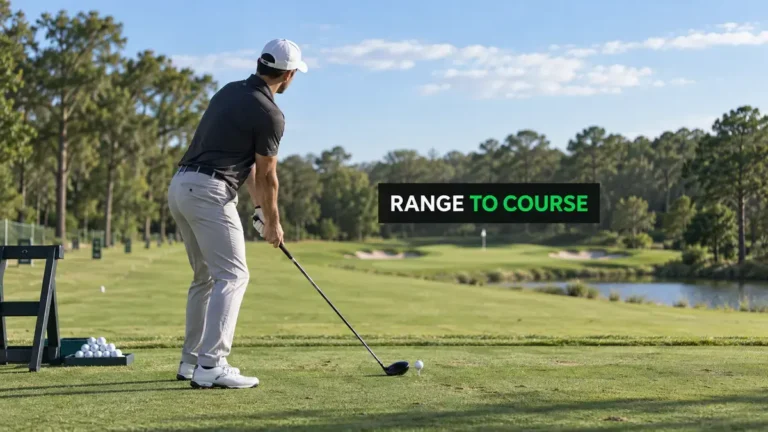

Should You Choke Down on Your Driver? Test Accuracy and Distance
You grip down on your driver for a tight hole, make a comfortable swing, and hit one of your better drives.
Now you are wondering why you do not hold the club that way all the time.
It is a fair question. Moving your hands slightly lower on the grip is easy to try, costs nothing, and may change how comfortably you control the club.
But one good drive is not enough to make the decision.
Choking down on your driver may improve contact and accuracy, but the distance tradeoff depends on your swing. Compare normal grip and gripping down using the same target, similar effort, and several shots before choosing.
Here is how I would run that test.
What Does Choking Down on the Driver Mean?
Choking down means moving both hands farther down the grip toward the clubhead.
You leave more of the grip extending above your top hand, effectively shortening the portion of the club you are swinging.
It does not mean squeezing harder.
Start with a small change—approximately half an inch lower than your normal hand position. Keep both hands fully on the grip and preserve your usual relationship between them.
If that feels comfortable, you can later compare a slightly larger adjustment.
You do not need to begin by moving your hands as far down as possible. A dramatic change makes it harder to tell whether you are testing a useful adjustment or simply reacting to an unfamiliar setup.

Why Gripping Down Might Help
Some golfers find the club easier to manage when they hold it slightly shorter.
That can make it easier to return the clubhead to the ball without feeling that they need to reach, steer, or make a last-second correction.
The possible benefit is more consistent contact and a smaller pattern of misses.
The PGA’s advice for playing golf in the wind includes gripping lower as an option to explore when solid contact matters.
That is a useful idea to test, not a promise that it will improve every golfer’s driving.
If your current hand position already produces centered contact and a dependable flight, gripping down may offer little benefit. It might even make the setup feel less natural.
Let the shots decide.
Will You Lose Distance?
Possibly, but do not assume a fixed number of yards.
Holding the club shorter can change clubhead speed, strike location, and the way you deliver the face. Those changes interact.
A small reduction in clubhead speed may be offset by better contact. On the other hand, if you already strike the driver well, a speed reduction may cost useful distance without producing much additional accuracy.
Trackman’s explanation of ball speed makes an important distinction: the speed of the ball leaving the face depends on more than how fast you swing the club.
That is why I would compare actual results instead of deciding from the feel alone.
A swing can feel slower and still produce a useful shot. A swing can also feel beautifully controlled while leaving you much farther from the green.
Both accuracy and distance belong in the test.
Practice Plan ALERT ALERT!! – Don’t miss these 50 practice routines I created, Day 1 to Day 50 as part of the Beginner Plan. You can also choose Intermediate or Advanced Plan if you’re trying to break 80 or scratch golf. Learn more how these plans help thousands of golfers just like you.
Set Up Naturally With the Shorter Hold
Take your new hand position first, then build a comfortable address position.
Do not keep your hands lower on the grip while forcing yourself to stand exactly where you stood with the longer hold. You may need to stand slightly closer so your arms hang comfortably and the clubhead reaches the ball.
Avoid making several unrelated adjustments at once.
For the initial comparison, keep these as consistent as practical:
- Ball position relative to your stance.
- Tee height.
- Intended target.
- Swing effort.
- Driver settings.
My driver setup guide gives you a useful starting checklist.
The purpose is to compare two comfortable grip lengths. It is not to combine gripping down with a new stance, a lower tee, a shorter backswing, and a different swing thought.
If you change everything, you will not know what helped.
Run This 20-Ball Comparison
Warm up first. Hit enough comfortable shots that your first scored drives are not also your first full swings of the day.
Then choose a target with clear left and right boundaries. Imagine a fairway that is realistic for the course you play.
Use two conditions:
- A: Your normal hand position.
- B: Approximately half an inch lower on the grip.
Hit four blocks:
- Five balls using A.
- Five balls using B.
- Five balls using A.
- Five balls using B.
This gives each option ten shots and reduces the chance that one benefits simply because you are more warmed up.
Take a normal pause between shots. Step back, choose the target, and go through your setup again.
Do not race through the bucket.
Record more than the best shot
Use a simple table:
| Result | Normal grip | Gripped down |
|---|---|---|
| Drives inside the target area | Out of 10 | Out of 10 |
| Clearly poor strikes | Out of 10 | Out of 10 |
| Major misses into imagined trouble | Out of 10 | Out of 10 |
| Typical carry, if reliably measured | Yards | Yards |
If you have reliable carry measurements, compare the middle of each group rather than the single longest drive.
If you cannot measure carry accurately, record an honest estimate or leave it blank. Do not turn a guess about where the ball landed into a precise distance claim.
My guide to finding your golf club distances explains why carry and total distance should be recorded separately.
Keep the Misses in the Results
Do not remove every poor shot from the test.
If you hit three major misses with your normal grip and only one while gripping down, that is part of the comparison.
Deleting the ugly shots can hide the very reason one option might help you.
You can make a note when something unusual happens, such as a distraction or a damaged range ball. But do not label ordinary mishits as irrelevant just because they hurt the average.
The question is how you normally perform with each option, including the imperfect swings.
Also record which side the major misses favor. A slightly tighter pattern is less useful if it moves toward the trouble you are trying to avoid.
How to Interpret the Results
There are several reasonable outcomes.
Accuracy improves and distance stays similar
That is a good reason to repeat the test on another day.
If the pattern holds, gripping down may be a useful normal setup or a dependable option for certain tee shots.
Accuracy improves but carry drops noticeably
Now consider the holes you play.
A shorter drive may still be useful when it leaves a clear approach. It may be a poor choice when you need to carry a bunker, reach a wider landing area, or avoid leaving an especially difficult second shot.
The tradeoff should fit the hole.
The results are almost identical
Choose the hold that feels comfortable and repeatable. You do not need to manufacture a change when the evidence does not show a benefit.
Contact or direction gets worse
Return to your normal position.
Gripping down is an option, not a checkpoint every golfer must adopt.
Don’t Use Gripping Down as an Automatic Slice Fix
Holding the club shorter does not guarantee a square face or a better club path.
If your slice improves, investigate what changed. Did you hit the center more often? Did the ball start closer to your intended line? Did the curve become smaller?
Those are useful observations.
But avoid concluding that every slice needs the same grip-length adjustment.
Likewise, a hook that improves during this test does not prove that the driver was too long. Your movement, balance, or face delivery may have changed as you reacted to the new hold.
Use the result to guide the next step, not to invent a diagnosis.
Confirm It With a One-Ball Test
Once one option looks promising, move beyond repeated shots at the same target.
Choose five imaginary holes on the range. Give each one a different target and describe the main trouble before hitting.
Hit one ball for each hole using the hand position you are testing.
Score one point when the drive finishes in a position that would leave a reasonable next shot. Record any miss that would likely create a penalty or force a recovery.
Repeat this on another practice day.
A grip position that works only after five consecutive rehearsals may need more practice before you trust it during a round.
Should You Cut Your Driver Shorter?
Do not make that decision from one good session.
Gripping down is a reversible test. Shortening a shaft changes the club’s build, and the resulting feel may differ from simply holding your current club lower on the grip.
If repeated testing strongly favors the shorter hold, bring those results to a qualified club fitter.
Explain what improved and what did not. Useful information includes your strike pattern, typical carry, major misses, and how much lower you held the grip.
That gives the fitting a clear problem to investigate.
You can also keep gripping down without making a permanent equipment change if it remains comfortable and effective.
Choose the Drive That Helps Your Next Shot
The best result is not necessarily the longest ball or the tightest group viewed in isolation.
You want enough distance to play the hole sensibly and enough control to avoid repeatedly starting from trouble.
Use the free Shot Leak Audit and Break 90 Blueprint to check whether driving penalties, poor contact, or another part of the game deserves your attention first.
Then explore the Foy Golf Academy practice plans for sessions that connect testing, skill work, and on-course decisions.
Start with a small grip adjustment, compare it fairly, and keep the option that gives you better playable drives over several sessions.