
How to Become a Better Putter in 10 Days
Most golfers do not need 21 different putting tips.
They need to figure out which part of their putting is actually costing them strokes.
When I work with golfers on putting, I usually want to separate the problem into three areas:
- Aim and start line
- Strike quality
- Speed control
A golfer who consistently starts five-foot putts to the right needs different practice than a golfer who starts the ball on line but leaves 30-foot putts six feet short.
Giving both golfers the same putting tip makes no sense.
That is why I would rather test your putting first.
Find the dominant problem.
Work on one thing.
Then retest it.
That process gives your putting practice a purpose instead of sending you to the practice green with another list of swing thoughts.
Stop Changing Your Putting Stroke Before You Know the Problem
Putting can feel complicated because a missed putt does not immediately tell you why it missed.
You can miss because:
- You aimed incorrectly
- The face was not where you expected at impact
- You struck the ball toward the heel or toe
- You misread the break
- Your speed was wrong
- Your routine changed under pressure
Sometimes more than one of those things happens on the same putt.
That is why watching five balls miss the hole and deciding, “My stroke is bad,” does not give you enough information.
Before changing mechanics, collect better feedback.
Start With Three Putting Tests
If I were evaluating a golfer’s putting, I would start with three simple tests.
You do not need a launch monitor.
You need a few tees, several golf balls, and a practice green.
The tests answer three questions:
Can you start the ball where you intend?
Can you strike the ball consistently?
Can you control how far it rolls?
Once you know which answer is weakest, your practice becomes much easier to organize.
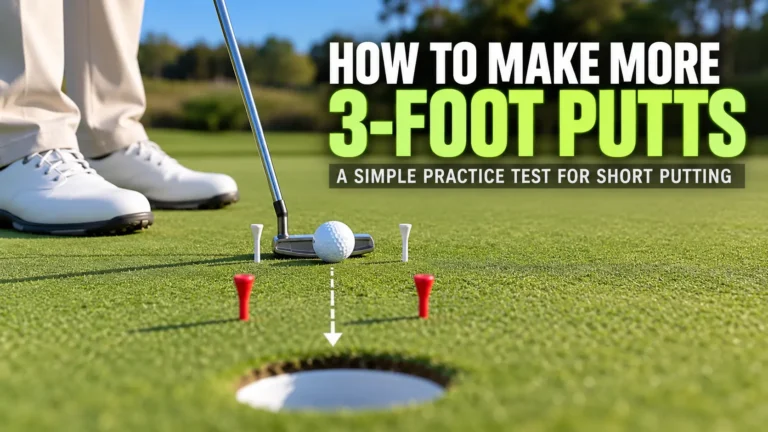
Test 1: The 5-Foot Start-Line Test
Find a reasonably straight five-foot putt.
Read it first and make sure you are comfortable with the line.
Place two tees approximately 12 to 18 inches in front of the ball, creating a gate slightly wider than the golf ball.
Hit ten putts.
Do not score only makes and misses.
Score whether the ball went through the gate.
Give yourself:
- 1 point = ball starts through the gate
- 0 points = ball hits or misses the gate
Your maximum score is 10.
What the Test Tells You
Suppose you make only five of ten putts but eight of ten start through the gate.
Your start line may be better than your make percentage suggests.
Green reading or speed could be contributing to the misses.
Now imagine only four of ten balls pass through the gate.
That tells us something different.
Before worrying about reading more break or buying another putter, I would work on your ability to start the ball where you intend.
Check Your Aim Before Rebuilding Your Stroke
This is one place where golfers often make unnecessary changes.
You may think your stroke is pulling the ball when you are actually aiming left.
Or you may feel like you push everything when your original aim was already right of your intended line.
Set the putter behind the ball.
Use an alignment stick or another clear reference on a straight putt.
Aim the putter face.
Then step away and look at where it is actually pointing.
I like the order:
- Choose the start line.
- Aim the putter face.
- Build the stance around that face position.
- Take one final look.
- Make the stroke.
Do not assume your eye position has to look exactly like somebody else’s.
Some golfers are comfortable with their eyes close to the ball-target line. Others see the line better with their eyes slightly inside it.
The better question is:
Can you aim the putter consistently from your setup?
For more on this part of putting, read my guide to mastering putting alignment.
Test 2: Check Your Strike Pattern
Golfers spend a lot of time discussing putter path and not enough time checking where the ball contacts the face.
Heel and toe strikes can affect the way the ball comes off the putter.
More importantly for the average golfer, inconsistent contact makes distance control harder.
You might make a similar stroke but produce different ball speeds because your strike moves around the face.
The 10-Putt Strike Test
Choose a flat putt of roughly five to eight feet.
Use impact tape, a removable face sticker, or another safe method for identifying where the ball contacts your putter.
Hit ten putts.
Record each strike as:
- Center
- Heel
- Toe
Do not make a stroke change during the test.
We are collecting information first.
What You Are Looking For
You do not need every strike to land on the exact same dimple-sized spot.
You are looking for a pattern.
Maybe eight of ten strikes are toward the heel.
Maybe the pattern is scattered across the entire face.
Maybe contact is actually very consistent and strike is not your biggest problem.
That last result is useful too.
A good diagnostic test should sometimes tell you not to change something.
How I Would Practice Inconsistent Strike
If face contact is scattered, simplify the practice.
Create a gate around the putter head with two tees.
Leave enough room for the putter to swing freely without clipping either tee.
Start with short putts.
Your goal is not to force the putter perfectly straight back and straight through.
Your goal is simply to improve your ability to return the putter to the ball consistently.
Hit ten putts.
Check the strike pattern again.
If it improves, continue.
If it does not, I would then look at setup variables such as:
- Distance from the ball
- Posture
- Ball position
- Stability during the stroke
Change one variable at a time.
Do not change grip, posture, ball position, stroke path, and tempo after one poor set.
Test 3: The 30-Foot Speed-Control Test
Now move away from short putting.
Find a relatively flat area and measure approximately 30 feet.
Create a three-foot circle around the hole using tees.
Hit ten putts.
Score:
- 2 points = finishes inside three feet
- 1 point = finishes between three and six feet
- 0 points = finishes more than six feet away
Maximum score: 20.
Also record whether each poor putt finished:
- Short
- Long
This tells you more than simply counting three-putts.
Why Speed Control Matters So Much
From long range, I am not expecting golfers to make putts consistently.
I want the second putt to become easy.
If you can turn a 30- or 40-foot first putt into a short second putt, you remove a lot of unnecessary stress from your round.
When I see golfers struggle with long-putt distance control, I often see them trying to control speed with a sudden hit at the ball.
The stroke gets similar in size, but the amount of effort changes.
I prefer teaching golfers to let stroke length do more of the distance-control work.
Longer putt?
Generally allow a longer stroke.
Shorter putt?
Use a smaller motion.
You can preserve a more predictable rhythm rather than trying to dramatically change how hard you hit each putt.
For more practice ideas, read how to master distance control on long putts.
Use a Distance Ladder Instead of Hitting the Same Putt Repeatedly
Once you establish a 30-foot baseline, make practice less repetitive.
Place markers at:
- 20 feet
- 30 feet
- 40 feet
Hit one putt from 20.
Then one from 30.
Then one from 40.
Repeat the sequence.
Your target is still the three-foot circle.
This forces you to recalibrate speed after every putt.
That is closer to what happens during a round.
You do not get five practice attempts from 32 feet before the putt counts.
You get one.
Pay Attention to Your Miss Pattern
This is where practice starts becoming useful.
Suppose your ten-putt test looks like this:
- 7 putts short
- 2 inside three feet
- 1 long
That is a clear pattern.
Now compare that with:
- 3 short
- 4 long
- 3 inside three feet
The second pattern is less consistent.
The practice goal may be different.
Do not just say, “I need better distance control.”
Identify what your distance-control problem actually looks like.
Your Putting Setup Should Support the Result
I still care about setup.
But I do not want golfers copying positions simply because they read that every good putter must stand a certain way.
A functional putting setup should allow you to:
- See your intended line comfortably
- Aim the face consistently
- Make a repeatable stroke
- Strike the center of the putter
- Control speed
That is the standard.
Grip Pressure
You need enough grip pressure to control the putter without creating unnecessary tension.
If you are squeezing the handle aggressively, soften it.
But I do not like assigning every golfer an exact grip-pressure number.
Find enough pressure to keep the putter stable while allowing the stroke to remain comfortable.
Ball Position
A starting point near the center or slightly forward of center works for many golfers.
But again, test it.
If contact, launch, and roll look poor, experiment with small changes.
Move the ball a fraction.
Hit another set.
Compare results.
Eyes and Posture
Do not force yourself into an uncomfortable position just because you have been told the eyes must be directly over the golf ball.
Your visual perception and setup need to work together.
What matters is whether you can aim consistently and return the putter predictably.
Build a Pre-Putt Routine You Can Actually Repeat
Technique is only part of putting.
Golfers also lose consistency because their routine changes when the putt matters.
A three-footer for par suddenly gets:
- Two extra reads
- Four practice strokes
- A longer stare at the hole
- More time standing over the ball
Now the golfer is performing a completely different process from the one practiced.
Keep the routine simple.
For example:
- Read the putt.
- Choose the start line.
- Make one rehearsal for speed.
- Aim the putter.
- Set your feet.
- Look at the target.
- Roll it.
Your exact routine can differ.
The important part is repeating it.
Separate Reading From Execution
Once you step into the ball, I do not want you continuing to debate the read.
Do your reading first.
Choose:
- Start line
- Speed
- Intended path
Then step into the putt and execute.
Standing over the ball thinking, “Maybe this actually breaks another inch,” is a great way to make an uncertain stroke.
Make the decision before you address the ball.
Read Breaking Putts With Speed in Mind
Line and speed are connected.
A putt hit more firmly generally takes a different path than one that dies near the hole.
That is why I do not want golfers choosing a line without imagining the speed that goes with it.
When reading a breaking putt:
- Look at the overall slope.
- Decide how you expect the ball to approach the hole.
- Choose the speed.
- Select the start line that matches that speed.
Then commit.
Practice Short Putts Differently From Long Putts
Do not use one putting drill for everything.
Short and long putts have different priorities.
Short Putts
From roughly three to six feet, emphasize:
- Aim
- Start line
- Strike
- Routine
A gate drill works very well here.
Long Putts
From 20 feet and beyond, emphasize:
- Speed
- Leave distance
- Adaptability
Use ladders and changing-distance drills.
That separation alone makes putting practice much more organized.
The 20-Minute Putting Practice I Would Use
You do not need to spend two hours on the putting green.
Here is a simple 20-minute session.
Minutes 1–5: Start Line
Hit five-foot putts through a gate.
Keep score.
Do not mindlessly hit balls.
Try to beat your previous result.
Minutes 6–10: Strike
Hit putts while checking contact location.
Use a putter-head gate if needed.
Focus on tightening the strike pattern.
Minutes 11–15: Speed
Rotate among 20-, 30-, and 40-foot putts.
Score how many finish inside three feet.
Minutes 16–20: Random Pressure Putting
Use one ball.
Change locations every putt.
Go through your entire routine.
Keep score.
That gives you technical feedback followed by practice that feels more like golf.
Retest Instead of Assuming the Drill Worked
This is one of the biggest changes I want golfers to make in practice.
Do not finish a drill and assume you improved.
Retest the original skill.
If your starting score was 5 out of 10 through the gate, practice for several minutes and run the exact test again.
Did you improve to 7?
8?
Did nothing change?
Do the same with speed control.
If your original 30-foot test produced 8 points out of 20, repeat it after practice.
The test tells you whether the change actually helped.
That is much more useful than saying, “My stroke felt pretty good today.”
Which Putting Problem Should You Practice First?
Use your test scores and your recent rounds together.
If short putts repeatedly start offline:
Work on aim, face control, and start line.
If contact moves around the putter face:
Work on strike consistency and setup.
If long putts leave difficult second putts:
Prioritize speed control.
If practice is good but performance breaks down on the course:
Spend more time on routine and one-ball pressure practice.
You may eventually need all four.
But you do not need to practice all four equally today.
Track Putting on the Course Without Making It Complicated
You do not need a spreadsheet with 25 putting statistics after every round.
Start with:
- Three-putts
- Missed putts inside five feet
- Approximate first-putt distance
- Approximate leave distance on long putts
Those numbers tell you much more than total putts alone.
A golfer can have 34 putts and putt reasonably well if they hit a lot of greens and constantly putt from long range.
Another golfer can record 30 putts while chipping close all day.
Context matters.
Use Your Misses as Feedback
After a missed short putt, ask:
Did it start where I intended?
After a long putt, ask:
Was the leave caused mostly by speed?
You do not need to analyze the stroke for five minutes during the round.
Make a quick note and use it later.
Practice is where you solve the problem.
The course is where you play.
Stop Looking for More Putting Tips
Most golfers already know enough putting tips.
The problem is deciding which one matters.
Instead of collecting another swing thought, test your putting.
Check your start line.
Check your strike.
Check your speed.
Then spend your practice time on the weakest result.
That is how I want putting practice to work:
Test → identify → practice → retest.
When you follow that process, you stop guessing.
And when you stop guessing, it becomes much easier to build a putting routine you can actually trust on the golf course.
Want fewer three-putts and big numbers? Get my free Break 90 Blueprint and Shot Leak Audit to identify which parts of your game are costing you the most strokes.
Want your putting practice organized for you? Explore the Foy Golf Academy Practice Plans for complete putting, short-game, and full-swing practice sessions.