How Far Should You Stand from the Ball? Simple Checks for Consistent Contact
Most golfers think of swing flaws as problems that happen during the motion, but many of the biggest issues begin before the club ever moves. One of the most common and overlooked setup errors is standing either too close or too far from the ball.
Your distance from the ball determines your posture, how your arms hang, and the radius of your swing. If that distance is off by even a few inches, your body has to make compensations on the way down just to find the ball, and those compensations show up as heel strikes, toe strikes, thin shots, fat shots, and inconsistent direction.
When you stand too close, the club is forced onto a steeper path and the body often stands up through impact to create space. When you stand too far away, the arms reach, balance shifts toward the toes, and the club struggles to return to the same low point and face position. In both cases, the swing becomes a series of reactions instead of a repeatable motion.
In this article, you’ll learn how far you should stand from the ball for every club, what correct distance looks and feels like at address, and how to check it with simple at-home and range drills. Once your setup distance is consistent, solid contact becomes much easier, and your swing can repeat without the need for last-second adjustments.
And at the end we will show you a practice plan that addresses this issue and gives you drills to follow. Our coaching team can also analyze your swing and give helpful feedback.
Free 7 Day Practice Plan
Get step by step drills to follow for fast improvement.
Why Distance from the Ball Matters
Your distance from the ball sets the radius of your swing and the way your body can rotate through impact. The club is designed to return to the ball on a consistent arc, and when you stand the correct distance away, that arc naturally bottoms out in the right place with the face square.
If you stand too close, the club has no room to swing and the body instinctively stands up to create space. This changes the swing plane, moves the low point, and often leads to heel strikes, pulls, and inconsistent contact.
If you stand too far away, the arms must reach and the upper body loses balance and posture. This makes it difficult to rotate, shifts the low point, and commonly produces toe strikes, thin shots, and weak ball flight.
The right distance allows your arms to hang naturally, your spine angle to stay stable, and your center of mass to remain balanced. When those pieces are in place, the club can return to the ball with far less compensation, making solid contact much easier to repeat.
What “Correct Distance” Looks Like at Address
At the correct distance from the ball, your arms should hang naturally from your shoulders without reaching or crowding. The hands will sit just a few inches in front of your thighs, with a small gap between your grip and your legs that stays consistent from club to club.
Your posture should feel athletic, with a slight bend from the hips, soft knees, and your weight balanced over the middle of your feet. You should not feel like you are leaning toward the ball or sitting back on your heels.
From this position, the club should rest on the ground with the sole flat and the shaft angled naturally toward your lead hip. If you feel cramped with your elbows tucked or stretched with your arms fully extended, your distance from the ball is likely off and will force compensations during the swing.
Standing Too Close to the Ball
When you stand too close, your arms have no room to swing on their natural arc. The body often responds by lifting up through impact or pulling the handle inward, which changes the swing plane and low point.
Common signs include heel strikes, pulled shots, steep divots, and a feeling of being “jammed” through impact. Many golfers who early extend or lose posture are simply trying to create space because they started too close.
Crowding the ball can also cause the clubface to close faster, leading to low hooks or pulls even when the swing path feels neutral.
Standing Too Far from the Ball
When you stand too far away, your arms have to reach for the ball and your balance shifts toward your toes. This makes it harder to rotate and maintain posture, often causing the club to bottom out early or the face to return inconsistently.
Common signs include toe strikes, thin shots, weak contact, and a feeling of losing balance during the swing. Reaching also reduces your ability to control the clubface, which can lead to blocks and high, weak fades.
Distance from the Ball by Club Type
As the clubs get longer, you will naturally stand a bit farther from the ball, but the relationship between your body and your hands should stay the same. Your arms should always hang in a similar position, and the change in distance comes from posture and shaft length, not from reaching.
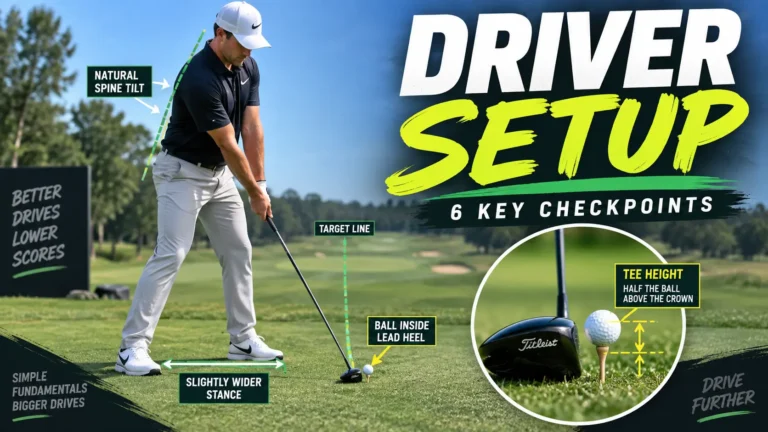
With wedges and short irons, you will stand slightly closer with a more upright posture. With mid and long irons, your posture tilts a bit more from the hips and the ball moves farther away. With fairway woods and the driver, your spine tilt increases and your stance widens, but your arms should still hang naturally under your shoulders.
If your arms feel stretched or cramped as the club changes, your distance from the ball is likely being adjusted incorrectly and will affect contact consistency.
Simple At-Home Distance Checks
A quick way to check your distance is the arm-hang test. Stand tall, let your arms hang naturally, then hinge forward from your hips. Your hands should fall in a position where the club can sit on the ground without you having to reach or crowd the ball.
Another simple check is the club-drop test. Set up to the ball, then let go of the club with your lead hand. If it falls straight down near your toe line, your distance is likely correct. If it falls toward your heels, you’re too close. If it falls away from your feet, you’re likely too far.
Range Drills for Distance Consistency
On the range, place two alignment sticks or clubs on the ground: one along your target line and one across your toe line. This gives you a visual reference for where your feet and body are relative to the ball.
Hit a few shots and pay attention to strike location on the clubface. Consistent center contact usually means your distance is correct, while repeated heel or toe strikes often point to standing too close or too far.
You can also rehearse your setup by stepping in, letting your arms hang, and checking that your balance feels centered before every shot. Repeating this process trains your body to find the same distance from the ball automatically.
Common Myths About Standing Distance
One common myth is that standing closer gives you more control. In reality, crowding the ball often leads to heel strikes, steep swings, and loss of rotation because the body has no room to move.
Another belief is that standing farther away creates more power. Reaching for the ball actually reduces leverage and balance, making it harder to square the face and strike the center of the club.
Some golfers also think their height alone determines how far they should stand. While body type plays a role, correct distance is really about arm hang, posture, and balance, not just how tall you are.
Building Distance from the Ball into Your Pre-Shot Routine
The easiest way to make your distance from the ball consistent is to set your posture first, then let the ball position and feet fall into place. Start by hinging from the hips, letting your arms hang naturally, and feeling your weight balanced over the middle of your feet.
From there, set the club behind the ball and step in so your hands return to that same hanging position every time. This prevents you from crowding or reaching and keeps your swing radius the same from shot to shot.
A quick visual check of your arm hang and balance before you pull the trigger helps lock in the correct distance and removes another variable from your setup.
Conclusion
Standing the correct distance from the ball allows your arms to hang naturally, your posture to stay stable, and your swing to return to the same radius every time. When that distance is consistent, the club can find the center of the face without your body needing to make last-second adjustments.
Most heel strikes, toe strikes, thin shots, and balance issues are not swing flaws at all, but simple setup errors caused by crowding or reaching. By using natural arm hang, checking your balance, and building distance into your pre-shot routine, you remove one of the biggest sources of inconsistency in the game.
Get the distance right, and solid contact becomes easier, your low point becomes more predictable, and your swing can repeat with confidence instead of compensation.
Golf Practice Plan – What to Do & Not To Do
Wonder why you’re not getting better as fast as you want to be? Here’s your proven system to follow step by step that hundreds of golfers like you are following each month. Our students send us emails frequently praising these practice plans and how much they’ve improved at golf.
Get access to our Practice Plans built for all 3 skill levels (Beginners, Intermediate, and Advanced Golfers).
You’ll learn what to do at the golf course to improve your score and skills and what not to do. Just follow these plans step by step. It’s made easy for you. Plus see our videos, worksheets, and training aid recommendations.
Thanks for reading today’s article!
Nick Foy – Golf Instructor