
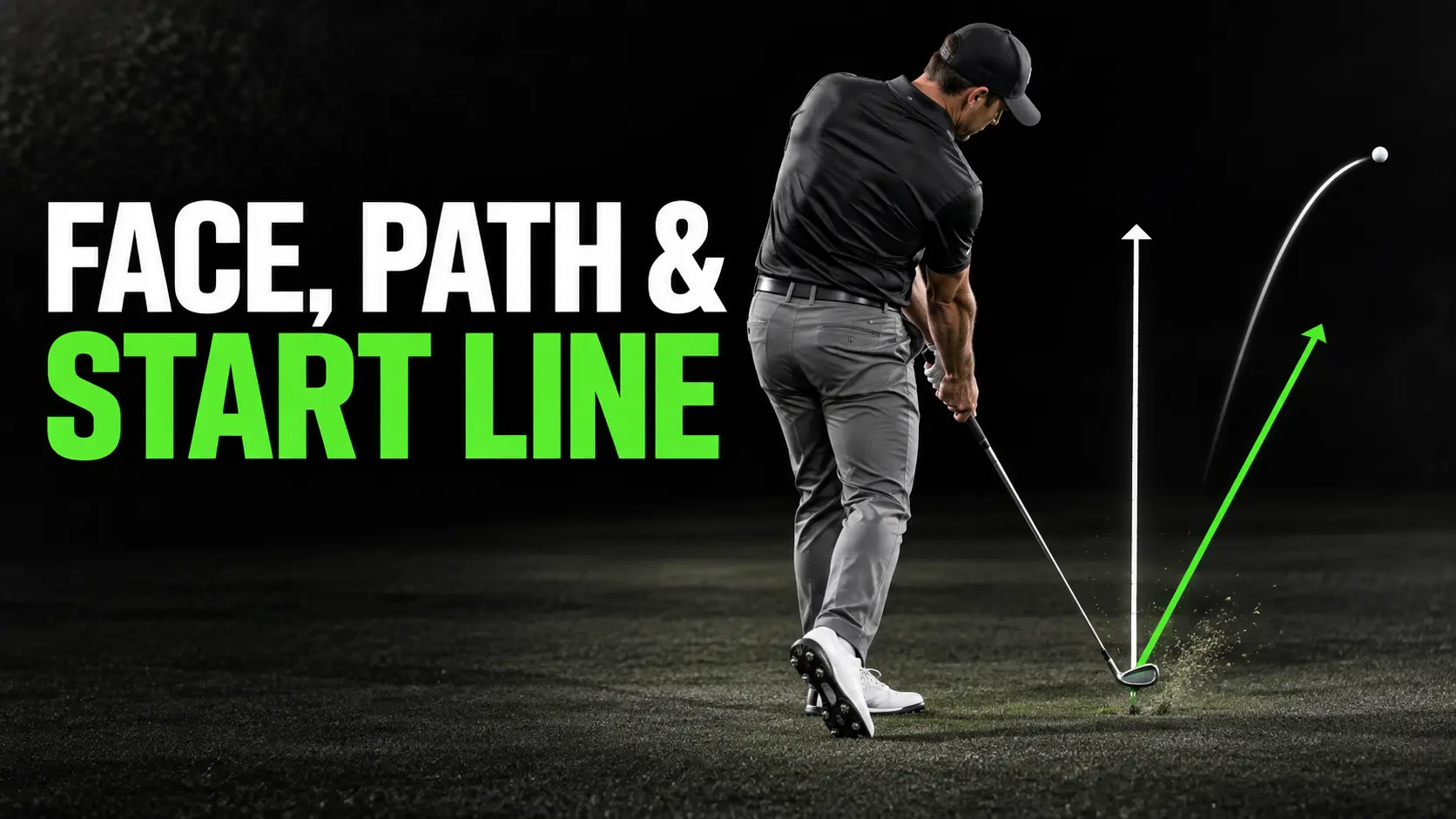
Swing Direction vs Club Path: Understand Your Ball Flight
A golfer can make a swing that looks smooth, strike the middle of the face, and still watch the ball miss the target. That does not mean the swing was almost perfect except for one mysterious flaw. It means the clubface and clubhead were delivered in a combination that sent the ball somewhere else.
When I help golfers understand directional misses, I start with three observations:
1. Where did the ball begin?
2. Which way did it curve?
3. Where did it strike the clubface?
Those clues are more useful than saying, “I came over the top,” or, “My path felt neutral.” Feel and appearance can be misleading. Ball flight gives us evidence.
Swing direction, club path, face angle, and strike location all contribute to that evidence. The terms sound similar, so golfers often mix them together. This guide separates them and gives you a practice test you can use even without a launch monitor.
Swing Direction and Club Path Are Not the Same
Swing direction describes the horizontal direction of the club’s overall swing arc at its lowest point. Club path describes the horizontal direction the clubhead is moving at the moment it contacts the ball.
Those two numbers can differ because impact may occur before or after the club reaches the bottom of the arc. Angle of attack, swing plane, and the location of the ball along the arc influence the path delivered at impact.
You do not need to calculate that relationship from a phone video. A launch monitor can measure it. Without one, use the ball’s start line and curve to identify the pattern you need to manage.
The practical distinction is simple:
Swing direction describes the general orientation of the swing arc.
Club path describes the clubhead’s direction through the ball.
Face angle describes where the clubface points at impact.
Face-to-path is the difference between face angle and club path.
For a centered strike, face-to-path is a major influence on curvature. A face open to the path curves the ball right for a right-handed golfer. A face closed to the path curves it left. A zero face-to-path relationship can produce a straight shot, but the shot can still travel left or right if both face and path point away from the target.
That last point matters. “Straight” does not always mean “at the target.”

What Controls Start Line and Curve
The clubface has the strongest influence on the ball’s starting direction. The club path contributes, but it does not overrule the face. The difference between the face and path helps create the spin-axis tilt that curves a centered strike.
This is where the old version of this article became confusing. It described a face square to the target, then claimed the ball would start right in one example and left in another. If the face points at the target, the ball should start close to the target line, not on the same line as an extreme path.
Use these right-handed examples instead:
Push draw
The ball begins right and curves left. The face was right of the target, while the club path was farther right. The face was closed relative to the path even though it was open relative to the target.
Pull fade
The ball begins left and curves right. The face was left of the target, while the club path was farther left. The face was open relative to the path even though it was closed relative to the target.
Straight push
The ball begins right and stays relatively straight. The face and path were both pointed right with a small difference between them.
Straight pull
The ball begins left and stays relatively straight. The face and path were both pointed left with a small difference between them.
Push slice
The ball begins right and curves farther right. The face was right of the target and open relative to the path.
Pull hook
The ball begins left and curves farther left. The face was left of the target and closed relative to the path.
These descriptions assume a centered strike. Heel and toe contact can change curvature, especially with a driver. Spray the clubface before blaming the swing direction.
For a deeper explanation, read my guide to face angle, club path, and golf ball flight.
Why Golfers Misdiagnose Directional Misses
One of the most common mistakes I see at the range is a golfer reacting only to the final location of the ball.
A shot finishes right, so the golfer tries to close the face. That can be the wrong change. A pull fade may finish right even though it started left. Closing the face can turn that pattern into a pull or pull hook without correcting the leftward path.
Another golfer sees a draw finish left and tries to swing farther right. If the existing path is already too far right, that makes the face-to-path gap larger and can produce more curve.
The final position does not tell the whole story. Separate the shot into start, curve, and strike.
| Free Break 90 Blueprint: Turn your shot pattern into smarter targets and practice priorities with my free Break 90 Blueprint and Shot Leak Audit. |
The 30 Ball Start and Curve Test
This test gives you a baseline, one focused practice block, and a retest. Use a 7-iron and a target safely within your normal carry distance.
Setup
Lay one alignment stick parallel to the target line.
Use face spray or impact tape.
Choose a center target plus a wide left and right boundary that represent playable misses.
Draw a nine-box chart in your notes: start left, center, or right across the top; curve left, straight, or right down the side.
Balls 1 through 10
Hit ten normal shots. Use your full pre-shot routine and step away after each ball.
Record:
1. Start line: left, center, or right.
2. Curve: left, straight, or right.
3. Strike: heel, center, or toe.
4. Finish: playable or outside your boundary.
Put each shot into the matching box on your chart. Do not change your swing during these ten balls.
Find the dominant pattern
Ignore one unusual shot and look for the combination that appears most often.
Mostly left starts with right curve suggest a pull-fade pattern.
Mostly right starts with left curve suggest a push-draw pattern.
Mostly right starts with right curve suggest the face is right of the target and open to the path.
Mostly left starts with left curve suggest the face is left of the target and closed to the path.
Mixed curves with scattered heel and toe strikes suggest contact needs attention before a path overhaul.
If no pattern appears, repeat the baseline on another day. Random changes do not justify a specific swing fix.
Balls 11 Through 20: Choose One Practice Constraint
For balls 11 through 20, choose one constraint that matches the dominant pattern. I do not want a golfer changing grip, takeaway, transition, and follow-through in the same ten-ball set.
For a pull fade or pull slice
Place a headcover four to six inches outside the ball and slightly behind it. Start with half swings. The goal is to approach the ball without striking the headcover, start the ball closer to the center target, and keep centered contact.
Move the headcover far enough away that you can swing safely. If you repeatedly hit it, increase the space. The drill should give feedback, not force a dangerous avoidance move.
For a push draw or push hook
Place an alignment stick on the ground along the target line and a second stick a few degrees right as a visual limit. Hit half swings while trying to start the ball inside the space between the two lines. The purpose is to reduce an exaggerated rightward delivery, not force the club straight down the target line.
For a start-line problem with little curve
Keep the same path intention and work on face control. Choose a visible start window a few yards wide at your target distance. Hit ten half shots and count how many begin inside it. A launch monitor or downrange intermediate target makes this easier to judge.
For scattered strike
Pause the path work. Spray the face and make ten waist-high swings. Try to group the strikes near the center. A path diagnosis built on heel-to-toe contact variation will be unreliable.
My guide to building a more consistent swing path includes additional drills, but use only the one that matches your pattern.
Balls 21 Through 30
Remove the training constraint and hit ten normal shots to the original target. Use the same routine as the baseline.
Score the test this way:
2 points: playable finish, centered strike, and intended start window.
1 point: playable finish with one clear miss in strike or start line.
0 points: finish outside the boundary or severe contact miss.
Compare the first ten balls with the final ten. Improvement means the dominant miss became smaller or less frequent while contact stayed stable. A single perfect shot does not prove the change worked.
If the retest becomes worse, remove the drill and return to your normal motion. The constraint may not match the cause, or you may need a coach or launch monitor to identify the delivery more accurately.
How to Apply the Pattern on the Course
You do not need a zero club path to play good golf. Plenty of playable shots curve. The goal is a pattern you can predict and aim for.
If your stock shot starts slightly left and fades, aim so the left start remains safe and the normal curve returns toward the target. If your stock shot starts right and draws, leave room on the right for the starting line. Do not aim directly at trouble and expect the curve to save you.
For golfers trying to break 90, I care about the three worst shots more than the seven decent ones. A golfer may hit seven playable tee shots but let three large curves find hazards or out-of-bounds areas. In that situation, I care less about producing a textbook path and more about shrinking those three misses.
During a round, record only three details after a directional miss: start, curve, and strike feel. Review the pattern later. Do not attempt a new swing-direction drill between holes.
Your Next Practice Session
Complete the 30-ball test and keep the chart. At your next range session, repeat the ten-ball baseline before using a training aid. If the same pattern returns, you have a clearer reason to work on it. If the pattern changes, contact, aim, or setup may be the more important variable.
| Practice with a plan: Put face, path, contact, short-game, and putting work into a complete routine with the Foy Golf Academy Practice Plans and 150-Practice Bundle. |
Start with the ball flight. Confirm the strike. Then make one change that addresses the pattern you actually have.