
When to Hit a Provisional Ball—and What to Say First
Your drive disappears toward the trees. Nobody sees it land, but someone says, “You’ll probably find that.”
You walk forward, search, and eventually realize you need to go back.
A provisional ball can prevent that return trip. But it only helps when you understand when it is allowed, announce it correctly, and know which ball to continue playing.
You may play a provisional when your original ball might be out of bounds or lost outside a penalty area. Before hitting, clearly announce that you are playing a provisional ball.
The easiest wording is also the clearest:
“I’m playing a provisional.”
Here is how I would organize the decision so you can handle it calmly during a round.
Make the Decision Before Leaving the Shot
After a questionable shot, keep watching until the ball disappears. Pick a specific landmark near where you last saw it.
A particular tree, bunker edge, or patch of taller grass is more useful than “somewhere over there.”
Ask your playing partners what they saw. Then decide whether there is a realistic possibility that the ball is out of bounds or lost outside a penalty area.
You do not need certainty that it is gone.
If you are already thinking, “We might have trouble finding that,” pause before putting the club away. This is the convenient time to consider a provisional.
The point is to avoid turning a possible search into an unnecessary walk back.

Know When a Provisional Is Allowed
The R&A’s Rule 18 provides the official framework.
Typical situations include a ball heading toward a boundary, disappearing into thick rough, or entering trees where it may be difficult to find.
The penalty-area distinction matters. If the only possible place the ball could be lost is inside a penalty area, the ordinary provisional-ball rule does not apply. If it could also be lost outside that area or be out of bounds, a provisional may be allowed.
Do not treat every disappointing shot as a reason to hit another ball provisionally.
A ball you can see sitting behind a tree presents a difficult next shot, but that alone does not justify a provisional. You need to deal with the original ball and the options available for that situation.
Say “Provisional” Before You Hit
Use the word that removes the uncertainty.
“I’m going to hit another one” is not a clear provisional announcement.
Neither is quietly thinking that the next ball is provisional while everyone else assumes you are replacing the original.
Tell someone before making the stroke:
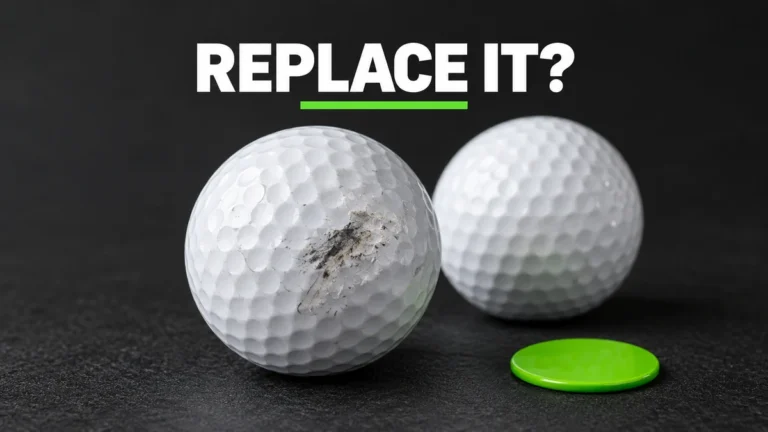
“I’m playing a provisional. This one has a green dot.”
The identification detail is helpful because two balls may finish near each other.
The USGA’s provisional-ball explanation covers the announcement and timing requirements. A provisional must be played before the three-minute search period expires. That search period begins when you or your caddie starts searching, not automatically when the shot is struck.
If nobody is nearby to hear your announcement, the rules allow you to play the provisional and inform someone when possible.
Practice Plan ALERT ALERT!! – Don’t miss these 50 practice routines I created, Day 1 to Day 50 as part of the Beginner Plan. You can also choose Intermediate or Advanced Plan if you’re trying to break 80 or scratch golf. Learn more how these plans help thousands of golfers just like you.
Make the Two Balls Easy to Tell Apart
Before your round, give your golf balls an identification mark you can recognize.
For a provisional, use a different number or an additional mark and tell your playing partners what it is.
For example:
- Original ball: number 1 with one blue dot.
- Provisional ball: number 3 with two blue dots.
This is preparation, not a complicated system.
Avoid relying on “the cleaner one” or “the ball that looks newer.” Both can become dirty after one shot, and another golfer may be using the same brand.
The easier you make identification, the less confusion you create when a search is already taking everyone’s attention.
Reset Before Hitting the Provisional
A provisional should get a real target and a normal routine.
Do not rush into the next swing because you are annoyed with the first one. That is an easy way to send two balls into the same trouble.
Step back, take a breath, and choose a shot you can commit to.
You do not have to repeat the original club choice. If the first drive exposed a target that was too aggressive, reconsider the club and landing area before playing again.
That does not mean automatically reaching for the shortest club. Choose an option that gives you useful progress and a realistic chance of keeping the ball in play.
The purpose is to prepare for the possibility that this ball will count.
What Happens When You Find the Original Ball?
Provided the provisional has not already become your ball in play, finding the original in bounds outside a penalty area within the allowed search time means abandoning the provisional.
You cannot choose the better lie.
If the original is under a tree while the provisional sits in the fairway, the fairway ball is not a free alternative.
You may need to play a recovery shot or use an available relief option with the original. My guide to hitting a punch shot under trees can help you assess the recovery rather than attempting a shot the opening does not allow.
If the original is found in a penalty area, or it becomes known or virtually certain to be there, abandon the still-provisional ball and proceed under the penalty-area rules.
When Does the Provisional Become the Ball in Play?
The USGA explains the main triggers in its guide to continuing with or abandoning a provisional.
The provisional becomes the ball in play when the original is out of bounds or lost outside a penalty area. It also becomes the ball in play if you make a stroke at it from a spot nearer the hole than where the original is estimated to be.
That second point is easy to overlook.
It is the location from which you play the next stroke, not simply where the provisional finishes, that matters.
You may continue playing it while it remains provisional from a spot the same distance from the hole, or farther away, than the estimated location of the original. Before doing so, be clear about that estimated location.
If the situation becomes uncertain, stop and establish the facts before making another stroke.
How Do You Count the Strokes?
Imagine a straightforward tee-shot example.
Your first drive goes out of bounds. You correctly announce and hit a provisional from the teeing area, and it finishes in the fairway.
Your count is:
- Original tee shot.
- One penalty stroke.
- The stroke made with the provisional.
Your next stroke from the fairway is your fourth.
Now change the example. Your original drive is found in bounds within the search time, before the provisional becomes the ball in play.
You abandon the provisional. Its strokes and penalties solely associated with playing it do not count. Your original tee shot still counts, and your next stroke with the original would ordinarily be your second.
Keep the two sequences separate until you know which ball is in play.
Practice Plan ALERT ALERT!! – Don’t miss these 50 practice routines I created, Day 1 to Day 50 as part of the Beginner Plan. You can also choose Intermediate or Advanced Plan if you’re trying to break 80 or scratch golf. Learn more how these plans help thousands of golfers just like you.
Practice the Decision Before a Tournament
You can rehearse this without hitting extra balls on the course.
Use three imaginary situations with a practice partner:
Situation 1: A drive disappears into thick rough
Ask yourself whether the ball might be lost outside a penalty area. Say the provisional announcement aloud and identify the second ball.
Situation 2: A ball is clearly sitting behind a tree
Recognize that a bad position does not create permission for a provisional. Think about the original ball’s next shot instead.
Situation 3: The original is found after a provisional was played
Explain whether the provisional is still provisional, then identify which ball you must continue with.
Give yourself one point for each correct decision and one point for each clear explanation. Aim for six out of six.
This is especially useful preparation for a newer competitive golfer. You want the procedure to feel familiar before frustration or tournament pressure enters the picture.
Reduce the Need for Provisionals Too
Knowing the procedure helps you manage a missed shot. Better target selection and more dependable contact can reduce how often you need it.
After the round, record what led to each questionable ball. Was it an aggressive line, a repeated curve, poor contact, or a club choice that brought trouble into play?
Use the free Shot Leak Audit and Break 90 Blueprint to connect those mistakes to a practice priority.
Then explore the Foy Golf Academy practice plans for structured sessions that build more reliable tee shots and recovery skills.
Before your next round, mark your golf balls, learn the announcement, and know the decision. A little preparation makes an awkward moment much easier to handle.