
Why You Hit Driver Off the Toe—and How to Fix It
You hit what feels like a solid drive, but the ball launches weakly, curves unexpectedly, or finishes well short of your normal distance.
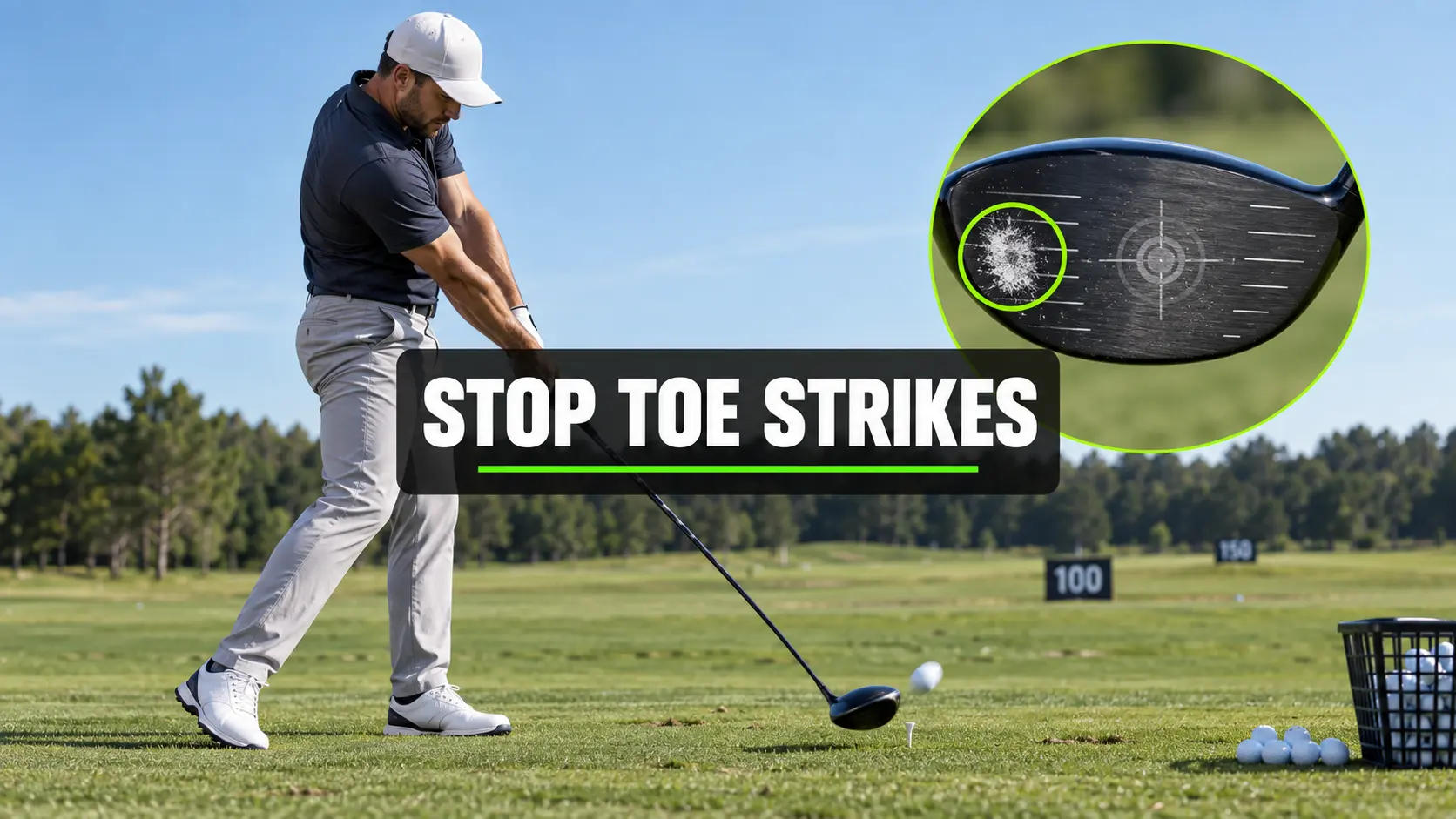
Look at the clubface and you may find the answer: another mark toward the toe.
Repeatedly hitting driver off the toe is not something you should diagnose from ball flight alone. A toe strike can reduce ball speed, twist the clubhead during impact, and alter the ball’s curvature. You may see a hook, a push that tries to curve back, or a shot that simply feels weak.
The good news is that you do not have to guess which part of your swing is responsible.
Use face spray to confirm the pattern, check your setup before rebuilding your swing, and test one change at a time. In this article, I will show you a 15-ball test that makes that process measurable.
Your eventual goal is simple: produce center-face contact on at least four out of five drives before increasing your speed.
Confirm That You Actually Have a Toe-Strike Pattern
Every golfer occasionally misses the center of the driver face.
One toe strike does not mean you need a swing change. Even two consecutive toe strikes may be a coincidence caused by poor balance, fatigue, or rushing your setup.
Before attempting a correction, apply foot spray, dry shampoo, or impact tape to the driver face. Hit five normal drives and look at the pattern.
You are trying to answer three questions:
- Are most of the marks actually toward the toe?
- Are they high, middle, or low on the toe?
- Are the marks grouped together or spread across the entire face?
A tight group toward the toe suggests a repeatable delivery problem. Marks covering the whole face suggest that general setup, balance, tempo, or swing control may deserve attention before you isolate a toe-specific fix.
Do not rely on feel. A shot can feel relatively solid while still missing the center.
If inconsistent contact is one of several problems costing you strokes, use my Free Break 90 Blueprint and Shot Leak Audit to identify which part of your game should receive the most practice time.
What a Toe Strike Does to Your Drive
The center of the driver face is designed to transfer energy into the golf ball efficiently. When contact moves far enough toward the toe, some of that energy is lost and the clubhead can rotate during impact.
That can reduce ball speed and change the spin axis of the shot.
Why Toe Strikes Can Hook
A driver’s center of gravity sits behind the clubface. On an off-center strike, the clubhead and ball can rotate in opposite directions during their brief interaction. This is called gear effect.
As Titleist’s explanation of gear effect describes, friction between the ball and a rotating clubface creates counter-rotation on the ball.
For a right-handed golfer, a toe strike commonly adds draw or hook curvature. For a left-handed golfer, the directions are reversed.
That does not mean every toe strike finishes left.
The face could still be sufficiently open at impact for the ball to start right and remain right. Your swing path, face angle, tee height, and exact strike location all influence the final flight.
This is why the mark on the clubface needs to be checked before making a diagnosis from the ball’s curve.
Why Toe Strikes Lose Distance
The farther contact moves away from the driver’s effective center, the less efficient the strike generally becomes.
You may notice:
- Lower ball speed than expected
- A dull or weak impact sensation
- Reduced carry distance
- Unpredictable launch and spin
- A larger difference between your best and worst drives
Before trying to create more clubhead speed, improve the strike. Swinging harder will not solve a contact pattern and may spread the impacts even farther across the face.
Cause 1: Standing Too Far from the Ball
Setup is the first variable I would test.
When you stand too far away, your arms must reach toward the ball. Your weight may shift toward your toes, and it becomes harder to maintain balance and return the driver to its original position.
The club can arrive with a shortened effective radius, placing the ball toward the toe of the face.
At address, your arms should hang naturally from your shoulders. You should not feel as though you are stretching your hands toward the ball.
If your arms feel completely extended before the swing begins, move slightly closer and rebuild your posture.
Use a very small adjustment. Moving approximately half an inch closer is enough for the test. Do not crowd yourself so much that the opposite miss moves to the heel.
For a more complete setup check, read How Far Should You Stand from the Golf Ball?.
Cause 2: Losing Your Distance During the Swing
A golfer can begin the correct distance from the ball and still change that distance during the swing.
If your upper body moves away from the ball, your pressure falls excessively toward your heels, or your arms pull inward through impact, the club may no longer reach the same point it occupied at address.
The result can be repeated toe contact.
Pay attention to your balance at the finish. If you frequently fall backward, step away from the ball, or finish with most of your pressure on your trail foot, the toe strike may be part of a larger balance problem.
Try making driver swings at 70% speed while keeping your chest, hips, and feet balanced through the finish. Reducing speed makes it easier to determine whether your body is moving away from the ball.
Do not force yourself to stay frozen. Your body must rotate. The goal is to rotate without dramatically changing your distance from the ball.

Cause 3: The Arms Pull Inward Through Impact
Some golfers shorten their swing radius as they approach the ball.
The elbows may bend, the hands may pull sharply toward the body, or the lead arm may collapse. Each action can move the clubhead inward and expose the toe.
A useful feel is to allow the arms to extend through the strike instead of trying to steer the driver.
This should not become a stiff, locked-arm motion. You are looking for width through impact, not tension.
Make a few slow rehearsals in which the clubhead travels through the space where the ball would be and continues toward the target. Then hit several drives at reduced speed while preserving that width.
If the strike immediately moves toward the center, the swing radius was probably contributing to your toe pattern.
Cause 4: Ball Position and Tee Location Keep Changing
Toe contact describes where the ball meets the clubface horizontally. Ball position usually receives more attention for changing launch and low point, but an inconsistent ball position can also change your delivery.
For example, a ball creeping too far forward may give your body more time to pull the handle inward or change posture before impact. Moving it too far back can alter your path and the orientation of the face when the club reaches the ball.
The point is not that one exact position fixes every toe strike. The point is that you need a repeatable reference.
For a driver, begin with the ball near the inside of the lead heel and confirm the position using an alignment stick across your stance.
Keep your stance width consistent during the entire test. A ball may appear to be in the same place relative to your lead foot while moving considerably relative to the center of your body.
My guide to ball position, contact, and shot shape explains how to test these variables without changing everything at once.
Cause 5: Your Driver May Be Difficult to Control
Technique is not the only possible factor.
A driver that is unusually long, poorly fitted, or difficult for you to control can make center contact less repeatable. That does not mean you should immediately purchase a new club or shorten your current driver.
First, test whether choking down slightly changes the contact pattern.
Grip approximately half an inch lower and hit five drives without changing anything else. If the strikes move toward the center and your ball speed remains competitive, the shorter effective length may be easier for you to control.
If contact changes dramatically based on where you grip the club, consider having the driver evaluated by a qualified fitter before making a permanent equipment change.
The 15-Ball Driver Toe-Strike Test
This test separates observation from guessing.
You will hit three sets of five balls. Use the same target, tee height, golf ball model when possible, and swing effort throughout the test.
What You Need
- Your driver
- 15 golf balls
- Face spray, dry shampoo, or impact tape
- Two tees for the contact gate
- One alignment stick
- A scorecard or notes app
- A fairway-width target on the range
Make each swing at approximately 70% to 80% effort. This is a contact test, not a speed test.
Score Each Shot
Give every drive one of these scores:
- 2 points: Center-face contact
- 1 point: Slightly off-center but still within your acceptable center area
- 0 points: Clear toe strike, heel strike, crown contact, or very low-face contact
Record the start direction and curve beside the contact score.
The goal is not merely to hit a straight ball. The goal is to connect the strike pattern with the ball flight.
Set 1: Five-Ball Baseline
Hit five drives using your normal setup.
Do not try to manipulate the strike. Go through your regular routine and make the swing you would use on the course.
After every shot, record:
- Strike location
- Start direction
- Curve
- Contact score
Photograph the face after the fifth ball before wiping it clean.
This establishes whether toe contact is a repeated pattern or an occasional miss.
Set 2: Five Balls from a Better Setup Distance
Reset the club behind the ball and build your posture from the ground up.
Stand tall, soften your knees, hinge from your hips, and allow your arms to hang naturally. Move approximately half an inch closer than your baseline setup if you were previously reaching.
Hit five more drives at the same speed.
Do not combine this change with a new grip, swing path, backswing, or release thought. You are testing distance from the ball.
Compare the five marks with your baseline.
If the pattern moves noticeably toward the center, retain the improved setup distance for the final set.
If the marks remain on the toe, return to the more comfortable setup and use the final set to test your swing radius.
Set 3: Five Balls Through a Driver-Face Gate
Place one tee in the ground just outside the driver’s toe and another just outside the heel while the club rests behind the ball. Leave enough room for the driver to pass safely between them.
The gate should provide feedback without interfering with the swing.
Use whichever setup produced the better contact during the first two sets. Make five swings while trying to return the middle of the driver through the gate.
Keep the speed at 70% to 80%.
If you are uncomfortable placing tees near the clubhead, create the same visual using two markings on a hitting mat or skip the physical gate and use face spray only.
Your Success Standard: Four Out of Five
I want you working toward at least four center or acceptable near-center strikes out of five before adding more speed.
Begin with three out of five if your current pattern is scattered. Once you achieve three consistently, progress to four.
When you can hit four out of five from the center area:
- Increase your speed slightly.
- Hit another set of five.
- Track whether the strike begins moving back toward the toe.
- Reduce speed again if contact breaks down.
The fifth shot still matters. If four drives find the center but one misses the entire face, your pattern is not as reliable as the score initially suggests.
Track both your success rate and the severity of the worst miss.
Do Not Fix a Toe Strike by Aiming for the Heel Forever
Intentionally trying to strike the heel can be a useful awareness drill, but it should not become your permanent driver thought.
The goal is to develop control over the clubface and then return the impact pattern to the center.
You can experiment with three rehearsals:
- Feel a strike toward the heel.
- Feel a strike toward the toe.
- Produce a centered strike.
This teaches you that face contact is a skill you can influence. Once you understand the difference, use a centered intention during normal swings.
A Simple Range Practice Progression
Use this progression during future driver sessions:
Stage 1: Contact
Hit five balls at 70% speed. Your goal is four out of five center-face strikes.
Stage 2: Start Line
Create a fairway-width target using two range markers. Hit five balls while maintaining your center-contact standard.
Stage 3: Speed
Hit five balls at normal playing speed. Record whether the contact remains centered.
Stage 4: Simulated Tee Shots
Switch clubs between drives or step away between shots. Go through your full routine and give yourself only one attempt at each simulated fairway.
This final stage prevents you from becoming good only when hitting the same driver swing repeatedly.
If you want structured sessions that combine contact work with the rest of your game, explore my Beginner, Intermediate, and Advanced Practice Plans. Each level includes 50 organized practices, or you can get all 150 sessions in the complete bundle.
Final Thoughts on Hitting Driver Off the Toe
A toe strike is evidence, not a complete diagnosis.
Confirm the pattern with face spray. Check your distance from the ball, balance, arm extension, and ball position before making a major swing change. Then use the 15-ball test to compare your normal setup with one controlled adjustment.
Most importantly, measure the result.
If moving slightly closer shifts the strike toward the center, you have found a useful setup change. If slowing down and maintaining width improves contact, your swing radius deserves more attention. If neither changes the pattern, you have ruled out two possibilities instead of continuing to guess.
Build toward four center-face strikes out of every five. Once you can produce that contact consistently, add speed and simulated fairways without losing control.
That is how a random toe strike becomes a problem you can actually diagnose, practice, and improve.