Neutral vs Strong vs Weak Grip: Which One Fits Your Swing?
Your grip is the only connection you have to the club, and it has a massive influence on what the clubface does through impact. Before you change your swing plane, your release, or your body motion, it’s worth understanding that the way you hold the club may already be steering the ball left or right.
Many golfers are told to use a “neutral grip” because it sounds correct, but the truth is that no single grip fits every swing.
A strong grip can help some players square the face and eliminate a slice, while it can cause others to hook the ball uncontrollably.
A weak grip can help players who over-rotate the face, but it can also make it nearly impossible to stop a fade or slice.
Grip strength affects wrist angles, how easily the face closes, how the club releases, and even how high or low the ball launches. Two golfers can make similar swings but hit completely different shots simply because their grips are different.
In this article, you’ll learn what defines a neutral, strong, and weak grip, how each one influences ball flight, and how to determine which grip best matches your swing pattern.
When your grip works with your motion instead of against it, clubface control becomes simpler and consistency improves without forcing timing or manipulation.
Free 7 Day Practice Plan
Get step by step drills to follow for fast improvement.
What Defines Neutral, Strong, and Weak Grip
Grip strength is defined by how your hands are rotated on the handle, not by how tightly you hold the club. The key references are the position of the lead hand, the direction of the “V” formed by your thumb and index finger, and how many knuckles you can see at address.
With a neutral grip, the lead hand sits so you can see about two knuckles when you look down. The “V” between the thumb and index finger points roughly toward your trail shoulder. This position sets the wrists in a balanced, neutral structure that allows the clubface to square naturally without needing excessive rotation.
With a strong grip, the lead hand is rotated more to the right (for a right-handed golfer), showing three or more knuckles. The “V” points more toward the trail shoulder or even outside it. This grip closes the clubface relative to the swing arc and makes it easier for the face to return shut, promoting draws and lower flight.
With a weak grip, the lead hand is rotated more to the left, showing only one or even zero knuckles. The “V” points toward the chin or lead shoulder. This opens the clubface relative to the arc and makes it harder for the face to close, encouraging fades and higher launch.
The trail hand supports the lead hand. In a neutral grip, its “V” also points toward the trail shoulder. In a strong grip, it tends to sit more under the handle. In a weak grip, it sits more on top.
Together, these positions determine how the wrists hinge, how the face rotates, and how easily the club can square at impact.
The Neutral Grip
A neutral grip places the hands on the club so the clubface can square naturally with the rotation of the body and arms. When you look down, you typically see about two knuckles on your lead hand, and the “V” formed by the thumb and index finger points toward your trail shoulder.
With this grip, the lead wrist can stay relatively flat or slightly bowed at impact, which helps control dynamic loft and face angle. Ball flight tends to be straight or gently curved, with a mid-range launch and spin profile.
The neutral grip is a good starting point for many players because it does not require excessive hand action to square the face.
However, if a golfer has a very steep swing, an early release, or limited rotation, even a neutral grip may leave the face open and produce a fade or slice.
Join the Foy Golf Academy Online Practice Club
Get weekly practice plans sent to you every Sunday plus analysis of your golf swing.
Learn More About the Practice ClubThe Strong Grip
A strong grip places the hands more to the trail side of the handle. You will usually see three or more knuckles on the lead hand, and the “V” between the thumb and index finger points outside the trail shoulder. The trail hand also sits more underneath the grip.
This position naturally closes the clubface relative to the swing arc and makes it easier to return the face square or slightly closed at impact. Ball flight tendencies are a lower launch with more right-to-left curvature, such as draws or, if overdone, hooks.
A strong grip often helps golfers who struggle with an open face, a slice, or an early release. However, for players who already rotate the body well or release the club aggressively, a strong grip can cause timing issues, pull hooks, and shots that start left and dive further left.
The Weak Grip
A weak grip places the hands more to the lead side of the handle. You will usually see only one knuckle, or even none, on the lead hand, and the “V” between the thumb and index finger points toward the chin or lead shoulder. The trail hand tends to sit more on top of the grip.
This position opens the clubface relative to the swing arc and makes it harder for the face to close through impact. Ball flight tendencies are a higher launch with more left-to-right curvature, such as fades or, if exaggerated, slices.
A weak grip can help golfers who consistently over-rotate the face, hit pull hooks, or deliver too much shaft lean with a very closed face. For players who already struggle to square the club or who release late, however, a weak grip often makes it nearly impossible to stop the ball from starting right and curving further right.
Check out the Practice Club with weekly practices emailed to you. Follow them step by step to lower your golf scores.
How Grip Affects Clubface at Impact
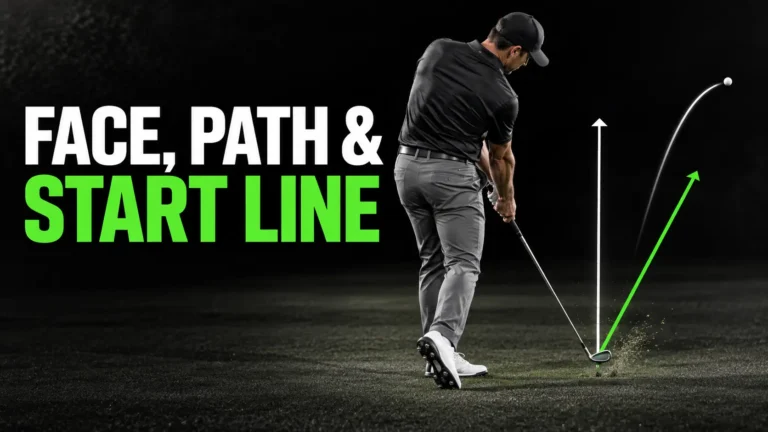
Your grip largely determines how your wrists are structured and how the clubface wants to behave as it approaches impact. A stronger grip sets the lead wrist in a more bowed position, which tends to close the face and reduce dynamic loft. A weaker grip sets the lead wrist in a more cupped position, which keeps the face more open and adds loft.
Because the club is rotating rapidly through the bottom of the swing, even small changes in wrist structure can have a big effect on start direction and curvature. This is why two golfers with similar swing paths can hit very different shots simply because their grips encourage the face to close earlier or later.
In simple terms, the grip influences how much the face wants to close, how soon it closes, and how stable it is through impact. When the grip matches your release pattern and body rotation, the face squares with less timing and manipulation.
Grip Choice Based on Shot Pattern
If you fight a chronic slice or weak fade, a grip that is too weak or too neutral for your release pattern may be leaving the face open. A slightly stronger grip can help the face square earlier and reduce the need to flip the hands.
If you fight a hook or pull hook, a grip that is too strong for your rotation speed may be closing the face too quickly. Moving toward a more neutral or slightly weaker grip can slow the rate of closure and stabilize the start line.
If you tend to block the ball right with little curve, the face may be staying open too long, often due to a weak grip combined with late release. If you pull the ball left with little curve, the face may be closing too early, often linked to a strong grip and fast forearm rotation.
The goal is not to chase a textbook grip, but to find the grip that allows your clubface to return square with minimal effort and consistent timing.
Want a 12 week program with drills, worksheets, and practices pre-made for your handicap (10-20) to help you Break 80 finally? Learn more about the Break 80 Program here.
Grip and Swing Type Compatibility
Your grip needs to match how you move the club and rotate your body. A steep, hand-dominant swing often benefits from a slightly stronger grip because it helps the face square without excessive flipping. A shallow, body-rotational swing often works better with a neutral grip because the face is already being delivered with good shaft lean and rotation.
Golfers who release the club early and struggle to keep the face from staying open may need more grip strength to help close it. Players who hold lag longer and rotate aggressively can often use a more neutral or even slightly weaker grip without losing face control.
There is no universal “best” grip. The right grip is the one that allows your swing to return the face square without timing the hands.
Simple Grip Checkpoints
A quick way to check grip strength is the knuckle count. Two knuckles is usually neutral, three or more is strong, and one or less is weak.
Look at the “V” formed by your thumb and index finger on both hands. In a functional grip, both V’s should point roughly toward your trail shoulder.
Check that the clubface is square when your lead wrist is flat at address. If the face looks open or closed when your wrist is neutral, your grip may be mismatched to your wrist structure.
Grip pressure should be firm enough to control the club but light enough to allow wrist hinge and release. Tension can override even a good grip.
Drills to Test and Train the Right Grip
A simple half-swing drill works well. Hit waist-high shots while focusing on returning the face square with minimal hand action. If the ball consistently starts right, your grip may be too weak. If it starts left, it may be too strong.
Another drill is the lead-wrist preset. Set your lead wrist in a flat position at impact and note where the clubface points. Adjust your grip so that a flat wrist produces a square face without manipulation.
You can also hit small sets of balls with slightly different grip strengths and watch the start line and curve. The grip that produces the straightest starting shots with the least effort is often the best match for your swing.
Building the Correct Grip into Your Pre-Shot Routine
Set your lead hand first, making sure the club runs diagonally across the fingers and the V points toward your trail shoulder. Add your trail hand so it supports the lead hand without overpowering it.
Check your knuckle count and face angle, then apply light-to-moderate pressure. A quick waggle should feel free, not tight.
When your grip is set the same way every time, the clubface behaves predictably and you no longer have to time the release.
Conclusion
Grip strength is not about right or wrong, it is about fit. A neutral grip suits many swings, a strong grip helps players who struggle to square the face, and a weak grip can stabilize players who over-rotate it.
The correct grip is the one that allows your wrists to deliver a square clubface with minimal manipulation. When the grip matches your release pattern and body rotation, ball flight becomes more predictable, timing becomes easier, and consistency improves without changing your swing.
Golf Practice Plan – What to Do & Not To Do
Wonder why you’re not getting better as fast as you want to be? Here’s your proven system to follow step by step that hundreds of golfers like you are following each month. Our students send us emails frequently praising these practice plans and how much they’ve improved at golf.
Get access to our Practice Plans built for all 3 skill levels (Beginners, Intermediate, and Advanced Golfers).
You’ll learn what to do at the golf course to improve your score and skills and what not to do. Just follow these plans step by step. It’s made easy for you. Plus see our videos, worksheets, and training aid recommendations.
Thanks for reading today’s article!
Nick Foy – Golf Instructor